
Business Advisory Services
Business Advisory Turns Organisational Complexity Into Action
Business advisory services provide practical, senior guidance to help organisations solve problems, assess opportunities and improve performance.
While the term can sound broad, the real value of business advisory services lies in helping leaders understand how their organisation works, including processes, systems, people and the resources that shape performance.
For many organisations, the challenge is not just “knowing someone’s responsible for doing that..” – Teams are often working hard, but the systems and processes around them may no longer support the complexity, pace or expectations of the organisation. The processes the team follows may have grown organically, or roles may now be unclear due to a structural or personnel change, and the reporting systems or metrics established may no longer provide the insight needed.
Business advisory services help bring structure to these situations, which if left for too long may lead to carrying issues or risk that has not been properly diagnosed.
Effective business advisory support examines how the organisation operates in practice in the bigger picture context. It should include reviewing governance arrangements, operational systems, compliance obligations, risk exposure, workforce capability, project delivery, service models, process performance and business outcomes, even if they don’t need to (or can’t) change.
The goal is to understand what is working, what is creating friction and what needs to change.
At Integris Group Services, business advisory is grounded in practical implementation. We work with organisations to translate strategic priorities into clear plans, usable systems and measurable actions. This can include support across strategy, operations, governance, compliance, risk, workforce systems, sustainability, transformation and growth.

Business Advisory Is About Better Decisions
One of the most important functions of business advisory is helping leaders make informed decisions.
Organisations often reach a point where decisions become harder because the information available is incomplete, inconsistent or spread across different teams. Leaders may know that something needs to change, but they may not have a clear view of the root cause.
For example, declining performance may appear to be a people issue, when the underlying cause is unclear accountability or poor process design. Compliance concerns may appear to be documentation issues, when the real problem is that policies are not embedded into everyday practice. Operational pressure may appear to be a resourcing issue, when the organisation is actually carrying duplicated work, inefficient workflows or unclear priorities.
Business advisory helps separate symptoms from causes, by bringing external perspective, structured analysis and practical consulting experience, advisors can help organisations understand the real issue before investing time and money in solutions.
This leads to better decisions, stronger prioritisation and more sustainable outcomes.

Good Business Advisory Starts With Understanding Process
At Integris Group Services, business advisory is grounded in process. Before an organisation can confidently move toward a future state, it needs a clear understanding of how work is currently performed.
Many organisations know they need improvement, but they do not always have visibility of the process reality behind performance issues. Workflows may be informal, duplicated, manual, inconsistent or dependent on individual knowledge. Systems may not reflect how teams actually work. Roles may overlap. Reporting may not show where time, effort or resources are being lost.
This is why current-state assessment is critical.
By mapping how work happens today, organisations can identify the friction points, gaps, dependencies and inefficiencies that are affecting performance. This creates a practical baseline for transformation.
Once the current state is understood, the future state becomes clearer.
Leaders can make better decisions about what needs to change, what should be simplified, what resources are required, which roles need to be clarified, and which enabling technologies can optimise or accelerate productivity.
This approach is particularly valuable when organisations are considering new systems, automation, digital tools or workflow improvements. Technology should not be applied to a poorly understood process. It should be selected and implemented based on a clear understanding of operational need, process design and desired outcomes.
At Integris, we help organisations connect process, people and technology so improvement activity is practical, targeted and sustainable. The aim is not simply to recommend change, but to create a clear pathway from current state to future state with the systems, resources and capability required to make that transformation work.

What Do Business Advisory Services Include?
Business advisory services can vary depending on the needs of the organisation. For Integris Group Services, the focus is on practical support that strengthens organisational systems and improves performance.
This may include:
- strategic and operational reviews,
- governance and compliance advisory,
- business assurance and internal audit,
- risk management framework development,
- workforce policy development and review,
- employee engagement and organisational diagnostics,
- process improvement and systems of work,
- PMO, change management and transformation support,
- tender, RFX and grant writing advisory, and
- sustainability, social responsibility and governance support.
The common thread across these services is implementation.
Advice is only valuable when it can be translated into action. A good advisory engagement should provide leaders with clarity on what needs to change, why it matters and how to move forward.

When Does an Organisation Need Business Advisory Support?
Organisations often seek business advisory support during periods of pressure, change or growth.
This may include situations where:
- the organisation has grown faster than its systems,
- governance or compliance obligations have become more complex,
- teams are unclear about roles, priorities or accountabilities,
- internal processes are inefficient or inconsistent,
- leadership needs independent review or assurance,
- change initiatives are not delivering expected outcomes,
- workforce engagement or culture issues are emerging,
- tenders, funding or growth opportunities require stronger positioning, and
- board and executive teams need practical support to make decisions.
Business advisory can also be valuable before problems become serious. Many organisations use advisory support to test assumptions, review systems, strengthen capability and prepare for future growth.
In this sense, advisory work is not only corrective. It can be preventative and strategic.

Would you like support to get through current challenges?
We help organisations understand what is really driving performance challenges, strengthen the systems behind their operations and turn insight into practical, sustainable improvement.
The Difference Between Advice and Implementation
Many consultants can provide recommendations. Fewer can help organisations implement them in a way that works in practice. This distinction matters.
Reports can identify issues, but organisations need practical support to turn insight into improvement. That may involve developing policies, redesigning workflows, preparing implementation plans, facilitating stakeholder discussions, supporting leaders, creating reporting tools or helping teams adopt new ways of working.
At Integris Group Services, our advisory model is designed to bridge the gap between strategy and implementation. We do not see advisory as a detached exercise. We work alongside organisations to help them build the systems, documentation, capability and confidence required to sustain improvement.
This is particularly important for not-for-profits, regulated organisations, public sector-adjacent entities and growing businesses where internal teams are often stretched and practical delivery capacity is limited.

The Role of Technology in Business Advisory
Technology can be a powerful enabler of business improvement, but only when it is aligned with the organisation’s real operating needs.
Many organisations adopt new systems hoping they will solve performance, reporting or productivity issues. However, technology rarely fixes unclear processes, weak accountability or poorly defined requirements on its own.
Before selecting or implementing enabling technology, organisations need to understand the current state of their operations. This includes how work flows across teams, where approvals occur, where information is duplicated, what reporting is required, and where manual effort is slowing performance.
Once the process reality is understood, technology decisions become clearer.
Leaders can identify which tools are genuinely useful, which workflows can be automated, which data should be captured, and which systems need to integrate. This reduces the risk of investing in platforms that create more complexity rather than improving productivity.
Effective business advisory helps organisations consider technology as part of a broader operating model. The question is not simply “what system should we buy?” The better question is “what process, resource and performance outcome do we need this technology to support?”
When technology is aligned with process, people and governance, it can accelerate improvement, reduce administrative burden and strengthen operational visibility.

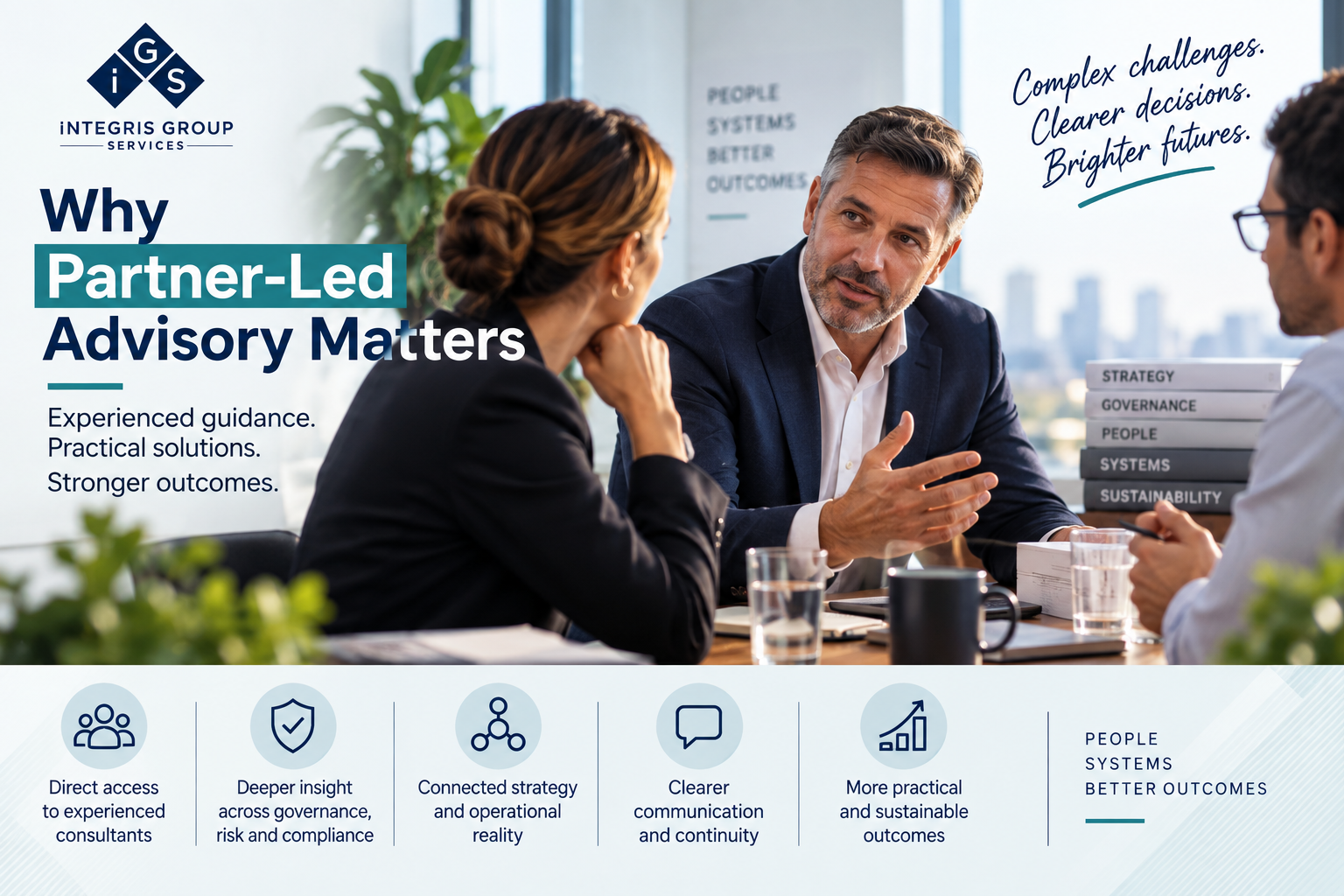
Why Partner-Led Advisory Matters
Business advisory services are most valuable when they are grounded in senior experience and genuine accountability.
A partner-led approach means organisations receive direct support from experienced consultants who understand governance, operations, compliance, workforce systems and organisational improvement. This creates stronger continuity, clearer communication and more practical outcomes.
Partner-led advisory is especially important when the issues are complex, sensitive or cross-functional. Governance, risk, compliance, workforce and operational challenges rarely sit neatly in one department. They often require judgement, context and the ability to connect strategy with operational reality.
For leaders, this means having a trusted advisor who can help clarify the issue, challenge assumptions and support practical action.
Building Stronger Organisations Through Advisory Support
The purpose of business advisory is not to make organisations dependent on consultants. The purpose is to strengthen internal capability.
Effective advisory support should help organisations improve how they make decisions, manage risk, use resources, support people and deliver outcomes. It should create clarity, confidence and momentum.
For Integris Group Services, business advisory is about helping organisations understand their current state, design a practical future state and build the systems, resources and enabling technologies required to get there. Whether the need is governance, risk, compliance, operations, workforce, assurance or transformation, the focus remains the same: practical support that helps leaders move from complexity to action.
Business advisory services are not just about solving immediate problems. They are about helping organisations become more capable, resilient and ready for what comes next.
Frequently Asked Questions
What are business advisory services?
Business advisory services provide organisations with experienced, practical guidance to improve decision-making, strengthen organisational systems and address operational challenges. This can include governance, risk, compliance, process improvement, workforce, assurance, transformation and strategic support.
How is business advisory different from traditional consulting?
Business advisory should go beyond identifying problems and producing recommendations. A practical advisory approach works with leaders to understand the current state, identify root causes and translate recommendations into achievable improvements that can be implemented and sustained.
When should an organisation consider business advisory support?
Business advisory can be valuable during growth, organisational change, increasing regulatory or compliance complexity, declining performance or when roles, processes and accountabilities are unclear. It can also be used proactively to strengthen systems, test assumptions and prepare for future opportunities.
Can business advisory help improve inefficient processes?
Yes. Business advisory can help organisations understand how work is currently performed, identify duplication, bottlenecks and unclear responsibilities, and design a more effective future state. This provides a stronger foundation for process improvement, automation and technology investment.
What role does technology play in business advisory?
Technology should support the organisation’s operating needs rather than drive them. Effective advisory first considers processes, people, governance and desired outcomes before determining where technology, automation or system integration can improve productivity and visibility.
Does Integris Group Services only provide recommendations?
No. Integris Group Services focuses on bridging the gap between advice and implementation. Support can extend from assessment and recommendations through to policy development, process redesign, implementation planning, reporting tools, stakeholder engagement and practical improvement support.
Would you like to see how business advisory support works in practice?
Explore how our management consulting services can help your organisation address challenges, improve performance, strengthen operations, and turn strategic priorities into practical action.