Governance, Risk and Compliance
Evaluating the Effectiveness of Your Policy Framework
Most organisations can tell you how many policies they have, which ones are due for review and, with a reasonably maintained policy register, who owns them. Many can also report to an executive team or Board that a high percentage of their policies are current.
Those are useful measures, but they do not answer the question that matters most:
Are our policies actually right for us?
Are they right for the organisation we are today, the services we provide, the people we employ, the risks we manage, the obligations we carry and the way we operate? Just as importantly, are they capable of supporting the organisation we are becoming?
For many leadership teams, these questions are surprisingly difficult to answer. The challenge is not usually that the organisation has ignored its policies. In fact, the opposite is often true. Considerable effort may have gone into maintaining them, reviewing them and obtaining the necessary approvals. The problem is that maintaining individual policies is not the same as knowing whether the policy framework as a whole is effective.
That distinction matters because policies are not simply documents. Collectively, they are part of the organisation’s governance system: they establish expectations, allocate authority and accountability, support the management of risk and provide the framework within which people make decisions and act.
So perhaps the most useful question for leadership is no longer “Are our policies current?” but rather:
“Do we have the right policies for our organisation, do they work effectively together, and what should we improve first?”
Policy Frameworks Rarely Become Complex by Design
Very few organisations deliberately set out to create a fragmented or unnecessarily complex policy environment. It tends to happen gradually, and usually for perfectly reasonable reasons.
A legislative change requires a response. An audit identifies a weakness. An incident leads to a new control. Accreditation creates additional requirements. A new service introduces different risks. The organisation restructures, responsibilities change, a new executive arrives or a business unit develops a policy to address an immediate operational need.
Each decision can make sense at the time. The difficulty is what happens when those decisions accumulate over five, ten or twenty years.
The organisation may eventually find itself managing a substantial collection of policies, procedures, frameworks, standards, plans, guidelines, codes and other documents that were developed at different times, by different people and for different purposes. Some have been updated repeatedly, others have been inherited from previous organisational structures, and still others may have been introduced without considering how they interact with documents that already exist.
The result is not necessarily a visibly dysfunctional policy framework. In fact, on paper, it may look quite organised. There may be a register, nominated owners, review dates and established approval processes.
The deeper questions are harder to see.
Are there policies covering the same issue in different ways? Are important areas missing altogether? Have responsibilities moved while the policies remained unchanged? Are operational procedures sitting inside policy documents? Are there documents that continue to be reviewed simply because they have always existed? Does one part of the organisation use different terminology from another? Are there policies that are individually reasonable but collectively inconsistent?
This is how an organisation can diligently maintain its policies without ever really determining whether those policies remain right for the organisation.

Are your policies right for your organisation?
A current policy is not necessarily an effective one. We can help you identify gaps, duplication, governance weaknesses and establish what should be improved first.
A Current Policy Is Not Cecessarily The Right Policy
Policy currency is important, but it is a relatively narrow measure of policy effectiveness.
A policy approved last month can still be poorly aligned with the organisation’s operating model. It may assign accountability at the wrong level, duplicate another document, establish controls that are disproportionate to the risk, contain procedural detail that belongs elsewhere or provide little clarity about what people are actually expected to do.
Conversely, an organisation can have an impressive library of recently reviewed policies while still having a significant gap in an area that has become critical to its operations.
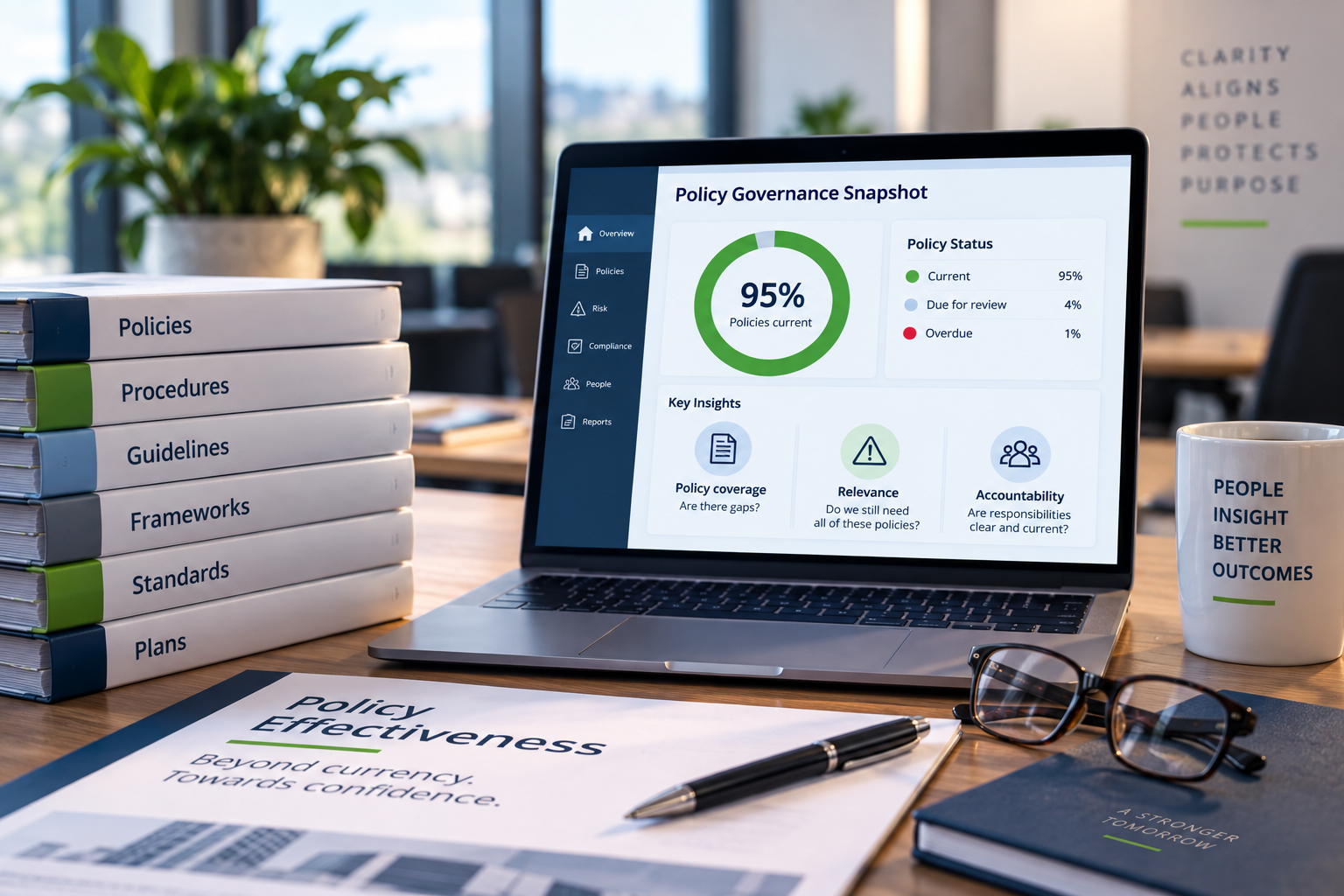
This becomes particularly important when policy currency is used as a proxy for governance assurance. An executive dashboard showing that 95 per cent of policies are current may demonstrate that the review process is functioning, but it does not necessarily demonstrate that the policy framework is effective.
Imagine the discussion changing from:
“Ninety-five per cent of our policies are current.”
to:
“Do we know whether we actually need all of them?”
That one question opens a very different conversation.
It leads naturally to others. Are any important policies missing? Where do we have duplication? Are accountabilities consistent? Are the policies practical? Are we maintaining documents that should be procedures or plans? What has changed in the organisation since the framework was designed? Which areas require significant improvement?
Suddenly, the percentage of current policies is useful context rather than the conclusion.
Start With the Organisation, Not the Policy Register
When a policy review begins with the existing policy register, there is a natural tendency to assess what is already there. Each document becomes the unit of analysis: review it, update it, approve it and move to the next.
There is another way to approach the question.
Start with the organisation.
What does the organisation exist to do? What services does it provide and to whom? How is it governed? How is authority delegated? What are its material risks? What regulatory, contractual, accreditation and funding obligations shape its operations? How complex is its workforce? Where are important decisions made? What requires consistency across the organisation, and where is local discretion appropriate? What has changed in recent years, and what changes are coming next?
Only after understanding that context can we meaningfully ask what the organisation’s policy framework should look like.
This is important because there is no universal policy library that represents good governance. The appropriate policy framework for a national human services provider operating across multiple jurisdictions is unlikely to be the same as the framework required by a small professional association. Even organisations within the same sector can reasonably require different approaches because their services, structures, risks, regulatory environments and governance arrangements differ.
An effective framework therefore needs to be contextual and proportionate. The objective is not to accumulate as many policies as possible or to replicate what another organisation has done. It is to establish the policy coverage and governance controls that this organisation reasonably requires. This principle sits at the heart of the IGS Policy Review and Improvement Service.

More Policies Do Not Automatically Create Better Governance
When an organisation identifies a new risk or governance issue, developing a policy can feel like a tangible and responsible response. Sometimes it is exactly the right response, but sometimes the organisation already has the necessary policy coverage and the real issue lies elsewhere.
Over time, adding a new policy every time a problem emerges can create a framework that is increasingly difficult to navigate and maintain. Employees may need to consult several documents to understand what is expected of them, responsibilities can become fragmented across policies, similar requirements may be expressed differently, and the administrative burden of keeping the entire framework current continues to grow.
At that point, more documentation can actually make governance less clear.
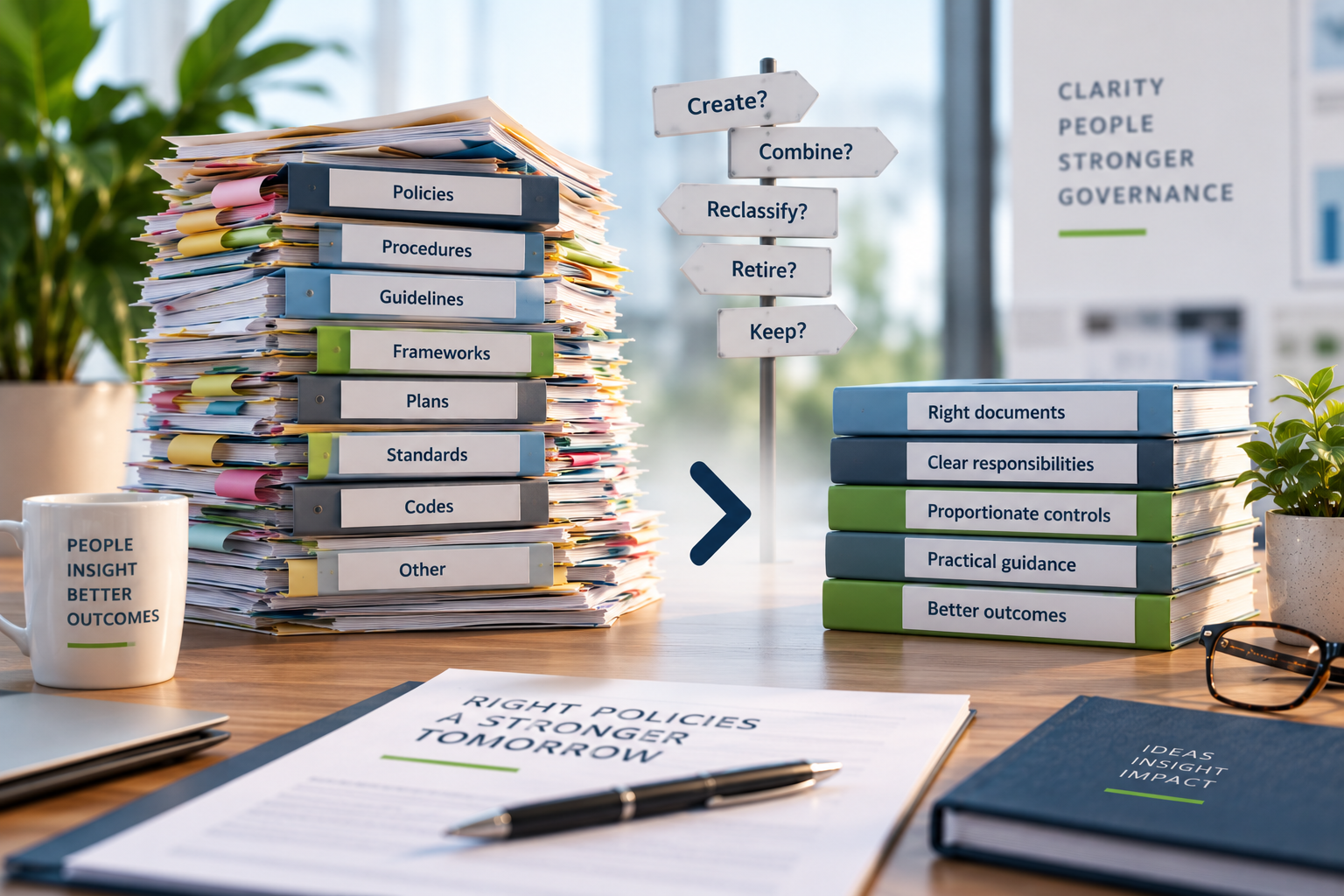
Strong policy governance is therefore as much about rationalisation and architecture as it is about policy development. A missing policy may need to be developed, but two existing policies may need to be consolidated. A document containing valuable operational content may need to become a procedure rather than remain a policy. A detailed response document may be better positioned as a plan, while an obsolete or duplicative document may no longer be required at all.
The IGS approach deliberately separates the question of whether a policy is effective from the question of what should happen to that document within the broader policy architecture.
This is an important distinction. A policy may be relatively effective but still be better merged with another document. Another may have significant weaknesses but remain essential and therefore require substantial redevelopment. A third may contain useful material but simply sit at the wrong level of the governance hierarchy.
The objective is not more policy. It is the right policy framework.
The Biggest Risks May Sit Between Your Policies
There is another limitation to reviewing policies individually: some of the most important governance issues only become visible when the documents are considered together.
A policy owner may reasonably review their own document and conclude that it remains fit for purpose. Another owner may reach exactly the same conclusion about theirs. Yet when the two documents are compared, they may allocate responsibility for the same activity differently or establish inconsistent approval requirements.
Scale that across an entire organisation and the significance becomes clearer.
Different policy families may use inconsistent definitions. Several policies may establish overlapping reporting obligations. Responsibilities may be duplicated between executives. The boundary between two functions may be unclear. Several documents may govern substantially the same subject matter, while an important issue sitting between functions is not addressed by either.
None of those issues necessarily emerges from a conventional document-by-document review.
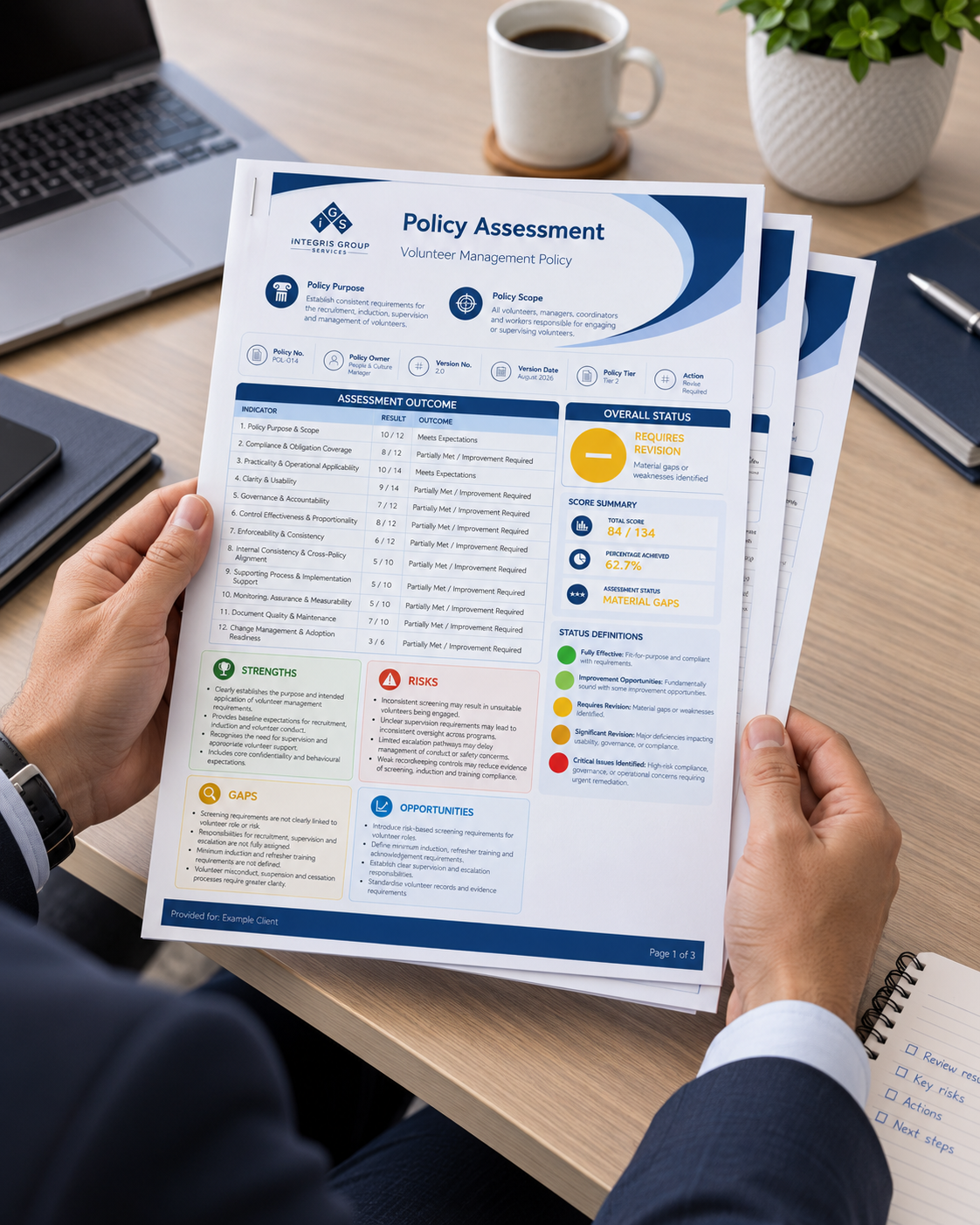
This is why cross-policy analysis is critical. The policy framework needs to reveal something that individual policy reviews cannot. The IGS methodology therefore considers recurring accountability gaps, inconsistent authorities, duplicated controls, conflicting terminology, unclear boundaries, missing supporting documents and opportunities to rationalise the framework.
A useful principle follows:
A framework can contain individually reasonable policies and still be collectively ineffective.
That is the point at which policy review becomes something more valuable than document maintenance. It becomes an assessment of how policy operates as a governance system.

Organisational Change Should Trigger a Policy Pulse Check
Policies inevitably reflect the organisation that existed when they were developed. The difficulty is that organisations rarely stand still.
Growth can introduce new management layers, services, locations, systems, risks and delegations. A restructure can fundamentally change who is accountable for what. A merger can bring together two different policy environments. New funding arrangements can create additional obligations, while new regulatory requirements can alter expectations around governance and control.
Yet the policy framework may continue to reflect the organisation that existed before those changes occurred.
This is why significant organisational change should trigger a broader policy question. Rather than simply asking which individual documents need amendment, leadership should consider whether the architecture, coverage and governance of the policy framework remain appropriate.
For a rapidly growing organisation, for example, the policies that worked when the organisation employed 40 people may not provide the governance required when it employs 400. Informal executive oversight may have been appropriate at one stage but become impractical as services, locations and management layers expand.
The question then becomes:
Is our policy framework fit for the organisation we are today and capable of supporting the organisation we are becoming?
That is a strategic governance question, not an administrative one.

What Does “Right for Us” Actually Mean?
Determining whether policies are right for an organisation requires a broader view of effectiveness than simply checking content and review dates.
Within the IGS approach, the policy framework is considered across six interconnected dimensions: Coverage, Quality, Governance, Compliance & Risk, Operational Effectiveness, and Assurance & Sustainability.
Together, these dimensions ask whether the organisation has the policies it reasonably requires; whether those policies are appropriately designed and coherent; whether ownership, authority and accountability are clear; whether relevant obligations and material risks are appropriately addressed; whether the policies can reasonably work in practice; and whether the organisation can monitor, maintain and improve the framework over time.
Importantly, this is not about pursuing an abstract standard of policy perfection. The purpose is to understand whether the framework is appropriate for this organisation, given its particular operating environment, governance arrangements, risks, obligations and future direction.
A good policy framework should enable effective governance. It should provide enough structure to create clarity and consistency without imposing unnecessary bureaucracy. It should make responsibilities easier to understand, not harder. And it should be capable of evolving as the organisation evolves.



How Integris Group Services Can Support
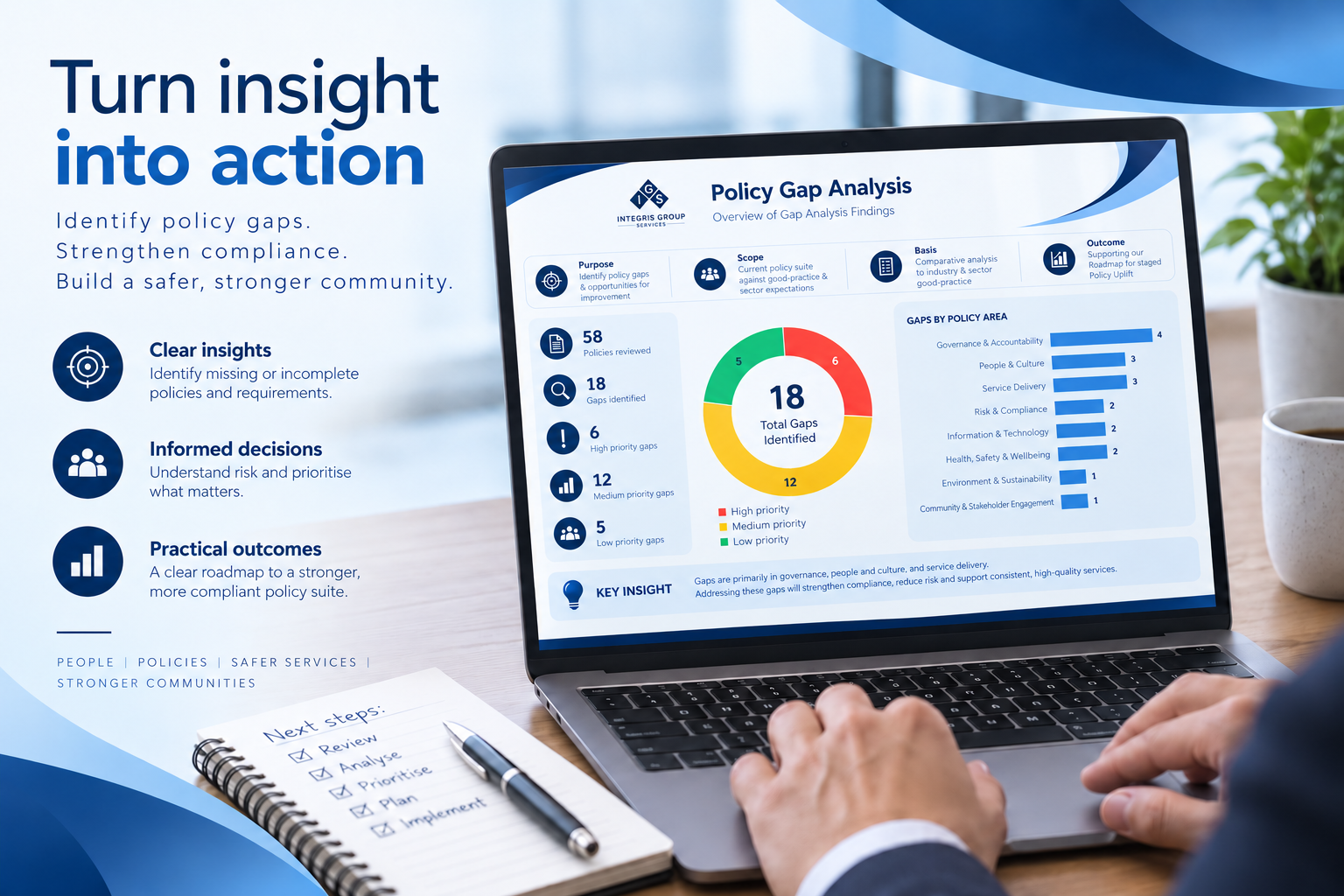
The IGS Policy Review and Improvement Service provides an independent, structured assessment of individual policies and the broader policy framework in which they operate.
Rather than simply identifying documents that need updating, the service helps organisations understand what is working, what is missing, where unnecessary overlap or complexity exists, what needs to change and what should be addressed first. The outcome is a practical roadmap towards a clearer, stronger and more sustainable policy governance framework.
For leadership teams seeking greater confidence in their policy environment, the starting question is simple:
Are our policies right for us?
Frequently Asked Questions
How do we know if our policies are actually fit for purpose?
A fit-for-purpose policy framework should reflect your organisation’s current operations, risks, regulatory obligations, governance arrangements and accountabilities. Currency alone does not demonstrate effectiveness.
How often should an organisation review its policy framework?
Individual policies may have scheduled review cycles, but broader reviews should also be considered when significant organisational change occurs, such as growth, restructuring, new services, regulatory change or changes in risk.
What should a comprehensive policy review examine?
A strong review should look beyond individual documents to consider policy coverage, quality, governance, compliance and risk, operational effectiveness, as well as assurance and sustainability.
Can an organisation have too many policies?
Yes. Excessive or overlapping policies can create duplication, unclear accountability and unnecessary complexity. Effective policy governance is about having the right policies, not simply more policies.
How can Integris Group Services support a policy review?
The IGS Policy Review and Improvement Service provides an independent assessment of individual policies and the broader policy framework, helping organisations identify strengths, gaps, duplication and priorities for improvement and develop a practical roadmap forward.
Not sure whether your policies are still right for your organisation?
We help organisations identify policy gaps, duplication and governance weaknesses turning review findings into clear priorities and a practical pathway for improvement.