

Executive Reporting for Better Decisions and Governance Assurance

Executive reporting exists to support better decisions, stronger accountability and improved organisational performance, not simply to present data. Integris Group Services works with boards, executives and senior leaders to strengthen the systems behind their reporting: how information is structured, who owns it, and how it connects to governance and risk oversight. A decision-centric approach replaces ad-hoc data with structured, audience-specific information and treats reporting as a governance capability rather than a technical output. Every report gains a clear purpose, a defined audience, a named owner and a regular review cadence.

Key Takeaways

Business professionals planning executive reporting frameworks with organized files and data.
  • Executive reporting works best when it is treated as a governance capability, not just a data presentation exercise.
  • A decision-centric framework gives every report a clear purpose, a defined audience, a named owner and a regular cadence.
  • Strong reporting depends on data quality, validation and escalation paths, not only on dashboard design.
  • Leading and lagging indicators both support decisions when they are linked to objectives, thresholds and a defined management response.
  • Boards and executives should regularly test their reporting against a short set of assurance-focused questions.

Why many executive reports struggle to drive decisions

Many executive reports struggle to drive decisions because they deliver data without structure. When metrics are inconsistent across reports, trust in the numbers can erode and decisions slow down. A management reporting framework defines who sees what information, when, and why. Without that framework, organisations can find themselves replacing structured insight with ad-hoc requests for yet another version of the numbers.

The cost compounds over time. Without a clear reporting foundation, performance tracking becomes inconsistent, and leaders can end up relying on opinion rather than reliable data. Boardroom discussion can shift from strategy toward disagreement over which figures are correct, a shift that carries a real cost in time and attention.

What separates decision-grade reports from data dumps?

Decision-grade reports are built to answer one question quickly: what action does this information call for? A data dump lists metrics; a decision-grade report connects those metrics to a choice the organisation needs to make. Decision-centric reporting filters out information that does not serve a specific decision, and aligns audience, cadence and content to that purpose.

How do inconsistent metrics affect leadership confidence?
When two reports show different figures for the same period, confidence in the numbers can suffer quickly. Executives may start relying more on instinct than on the data in front of them, which weakens the shared picture a leadership team needs to govern effectively. Rebuilding that confidence generally requires a framework with clear ownership, defined audiences and a consistent cadence. Integris Group Services works with clients through its governance, risk and compliance support service to embed these principles so reporting systems support governance rather than undermine it. Effective executive communication strategies reinforce this structure, making clarity a system-level outcome rather than an afterthought.

Executive dashboards can help by accelerating comprehension through visual summaries, but a dashboard without a framework is still just a more attractive way of presenting unstructured data. The more durable fix is structural: define the report hierarchy, map each report to the decision it supports, and assign clear ownership. Organisations that make this shift tend to use reporting for action rather than for reporting’s sake.

Executive team reviewing a decision-centric reporting dashboard for organizational governance and performance.

Building a decision-centric reporting framework

A decision-centric reporting framework structures information flow so decision-makers receive what they need to act, as part of a broader approach to governance and assurance. It replaces scattered data with a deliberate system built around decision-usefulness, supported by clear ownership and consistent definitions.

The framework defines who sees what information, when, and why. In practice, this typically rests on five components:

Five components of a decision-centric reporting framework:

ComponentWhat It Governs
Report hierarchyStrategic reports flowing down to operational detail
Audience mappingMatching report content to specific decision-makers
Content standardsConsistent metrics, definitions, and presentation
Frequency cadenceRegular timing aligned to decision cycles
Clear ownershipOne person accountable for each report's quality

Every report in the system needs an owner, a defined audience and a regular cadence. Without these three elements, reporting tends to drift: reports arrive late, metrics shift without explanation, and confidence in the numbers declines.

Why does decision-usefulness matter more than data volume?

A report’s value is not measured by how much data it contains, but by whether it helps resolve the decision at hand. A dashboard with forty metrics still fails if none of them answer the question the board needs resolved this week. A decision-centric framework applies a simple filter: does this data point support a specific decision? If not, it may not belong in the executive pack.

How does report hierarchy connect strategy to operations?

Report hierarchy links board-level indicators to divisional and operational metrics, so a CEO tracking revenue growth is working from the same underlying data as the manager monitoring daily throughput. This alignment, supported by strong governance, risk and compliance frameworks, helps keep accountability flowing downward while insight flows upward. Content standards keep definitions consistent across levels, so a term like customer retention means the same thing in the boardroom and on the operations floor.

How executive dashboards support better trade-off decisions

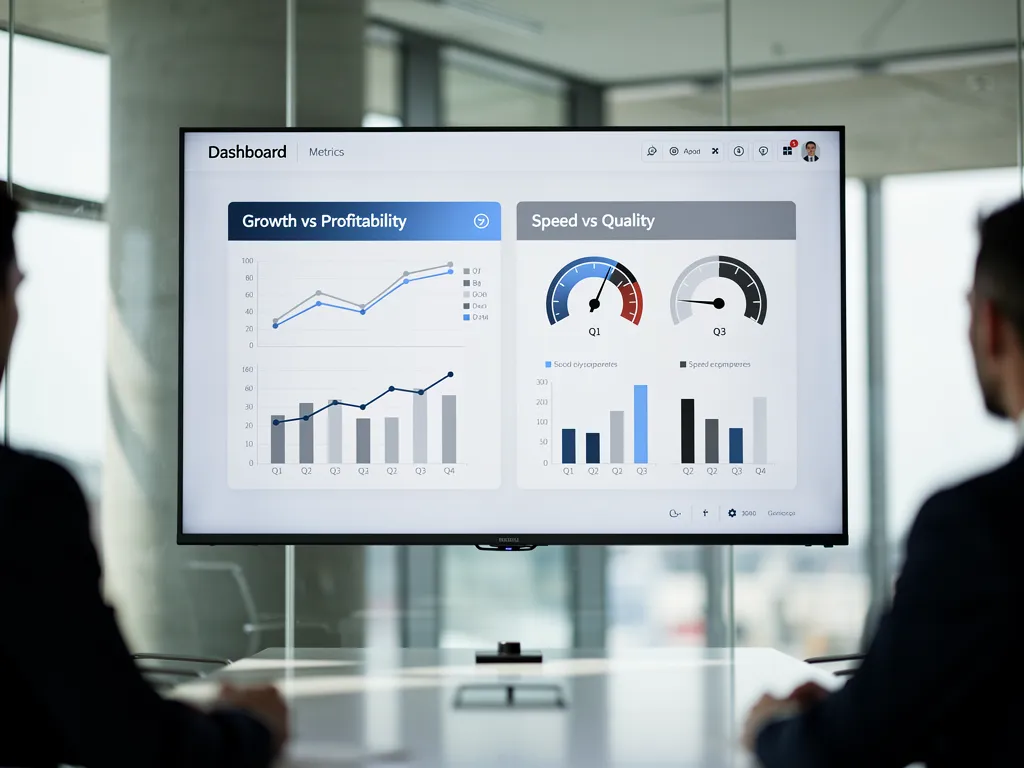
Executive dashboards work best when they help leaders see the trade-offs behind a decision, not just the metrics themselves. A dashboard that displays numbers without framing the tension between competing priorities, growth against profitability, speed against quality, can leave decision-makers without the context they need. Decision-centric reporting asks every visual element to support one question: what is gained and what is given up by acting on this information?

Building dashboards this way starts with resisting the temptation to show everything. A management reporting framework brings discipline to what appears on screen, defining the audience, the cadence and the specific decisions each dashboard is meant to support.

What separates a decision-focused dashboard from a monitoring dashboard?

A monitoring dashboard tracks performance. A decision-focused dashboard helps compare options. A monitoring view might show revenue trending upward; a decision-focused view sets that growth against its effect on profitability, so the trade-off is visible rather than implied. Decision-focused KPIs are generally most useful when paired with a counterweight: growth against profitability, speed against quality, investment against liquidity.

How does a dashboard support, rather than replace, management judgement?

Visual design can carry a lot of the analytical load. Side-by-side scenario panels let executives compare outcomes directly, and colour coding or threshold lines can highlight where one priority starts to outweigh another. But a dashboard supports interpretation, it does not replace it. The data still needs context, management judgement and, where the stakes are high, a defined escalation path so the right people are involved in the decision.

Integris Group Services works with clients through its management consulting and operations consulting service to connect dashboard design to the governance and risk settings behind it, so reports frame each metric as a decision with consequences, not a number in isolation.

Executive reviewing decision-focused KPI dashboards for governance and strategic reporting in Melbourne.

What are decision-focused KPIs, and how should they be set?

Decision-focused KPIs are metrics chosen to support a specific decision, not simply to report what already happened. They connect to strategic choices and give executives information they can act on, alongside the lagging measures that show how the organisation has performed.

Do decision-focused KPIs replace standard metrics?

Not quite. Both leading and lagging indicators have a role. A revenue figure or a churn rate reported after the fact still matters, because it shows whether earlier decisions worked. What makes any metric decision-focused is whether it is linked to an objective, a threshold that triggers a response, and a defined owner who acts when that threshold is crossed. The distinction is less about which metrics are used and more about whether each one is connected to a decision the organisation is actually prepared to make.

What framework supports effective KPI selection?

A structured management reporting framework, built on report hierarchy, audience mapping, content standards, cadence and clear ownership, gives KPI selection a consistent foundation. Setting effective KPIs generally follows three steps: map each metric to a specific decision the leadership team faces on a regular cycle; assign clear ownership so accountability is unambiguous; and set thresholds that trigger a defined response rather than passive review.

Executive dashboards then surface these KPIs visually, filtering noise and highlighting the variances that need attention. Integris Group Services supports this work through its risk and opportunity management framework, which helps organisations connect KPI thresholds to risk appetite and escalation paths rather than treating them as numbers in isolation.

A practical framework for improving executive reporting

Moving from ad-hoc reporting to a decision-centric, governance-ready system tends to follow a consistent sequence:

  1. Clarify purpose. Define the specific decision or decisions each report exists to support.
  2. Map the audience. Identify who the report is for and what they are accountable for deciding.
  3. Select decision-focused KPIs. Choose metrics linked to objectives and thresholds, not just available data.
  4. Assign data ownership. Name the person accountable for each report's accuracy and timeliness.
  5. Validate the data. Build in checks that catch inconsistent definitions or figures before they reach the board.
  6. Define escalation paths. Set out what happens, and who is involved, when a threshold or risk appetite limit is crossed.
  7. Review on a fixed cadence. Match reporting frequency to the decision cycle it supports.
  8. Improve continually. Revisit the framework as decisions, risks and priorities change.

Integris Group Services works with leadership teams through its policies, procedures and assurance consulting service to build these checks and escalation paths into reporting systems, so data quality and assurance sit alongside dashboard design.

Questions boards and executives should ask about their reporting

A short set of questions can reveal how decision-ready an organisation’s reporting really is:

  • Does each report connect to a specific decision the board or executive team needs to make?
  • Who is accountable for the accuracy of the data behind each report, and how is it validated?
  • What happens when a KPI crosses its threshold, and who is notified?
  • How consistent are definitions and figures across different reports covering the same period?
  • Would removing a metric from the report change any decision we currently make?

Complex industrial model displaying data dashboards for executive reporting and organizational governance.

How to create decision-centric reports in your organisation

Decision-centric reporting turns raw data into structured intelligence that leadership can act on. Organisations that build their reporting around decisions, rather than generic metrics, tend to spend less time reconciling inconsistent numbers and more time acting on clear signals.

Executive dashboards are the visible layer of a decision-centric system, but the real work happens beneath the surface: in data ownership, validation, escalation and governance. Integris Group Services works with leadership teams across Australia and New Zealand to help translate governance, compliance and operational complexity into reporting systems that hold up in practice.

Who should own the reporting design process?

Ownership sits with the executive team, not with the analytics function alone. Treating decision-centric reporting as a leadership discipline, rather than a technical exercise, is what embeds it into governance rather than leaving it as a side project.

Building decision-centric reports generally requires three structural commitments:

  • Audience mapping that defines exactly which decisions each report supports
  • Cadence alignment that matches reporting frequency to decision timelines
  • Content standards that filter out data lacking decision relevance

Reports built this way tend to earn attention. Reports built without this discipline tend to go unread.

FAQs

How do we know if our executive reporting is actually effective?

Effective reporting is judged by whether it changes or confirms a decision, not by how much data it contains. If removing a report would not change any decision the organisation makes, that is a sign the report needs rethinking.

How should we choose which KPIs to report to the board?

Select KPIs that are tied to a specific objective, paired with a threshold that triggers action, and owned by a named person who is accountable for the response, rather than metrics chosen simply because they are easy to measure.

How do we build assurance into our reporting, not just better dashboards?

Assurance comes from validating data before it reaches decision-makers, defining escalation paths for when thresholds are crossed, and reviewing the reporting framework itself on a regular cycle, not from dashboard design alone.

Who should be accountable for executive reporting?

Accountability sits with the executive team and each report’s owner, not solely with the analytics or finance function. Governance works best when leadership treats reporting as its own responsibility.

How can Integris Group Services help with reporting and governance?

Integris Group Services works with boards and executive teams through services including governance, risk and compliance support, management consulting and operations consulting, and policies, procedures and assurance consulting, helping organisations build reporting systems that support confident, well-governed decisions.

Ready to Strengthen Your Reporting Governance?

Decision-centric reporting works best when it is backed by the right governance, risk and consulting support. Integris Group Services can help your board or executive team put these principles into practice.

Contact Us Speak with our team about strengthening your reporting framework.

Book a Consultation Arrange a session to review your current reporting and governance arrangements.

Governance, Risk and Compliance Support Build the governance foundations that decision-centric reporting depends on.

Management Consulting and Operations Consulting Connect reporting design to the operational systems behind it.

Risk and Opportunity Management Framework Link KPI thresholds and escalation paths to your organisation’s risk appetite.

Conclusion

Decision-centric reporting is ultimately a governance capability: it strengthens oversight, sharpens accountability and gives decision-makers confidence in the numbers in front of them. Reporting built this way does not just describe the business, it helps govern it, with clear ownership, defined escalation paths and a cadence that matches real decision cycles.

The next step belongs to the executive team: test current reporting against the questions above, and look honestly at whether each report supports a specific decision or simply adds to the noise. For organisations ready to strengthen that foundation, Integris Group Services can help through a structured review of governance, risk and reporting arrangements. Book a session to discuss what that could look like, or reach out at contact@integrisgroupservices.com.au.