How can organisations effectively address the risks associated with hazardous manual handling tasks?
This question has spurred transformative changes in workplace safety approaches, with many businesses now embracing innovative, collaborative frameworks to protect their teams. At the forefront of this movement, Integris Group Services (IGS) has partnered with organisations to advance safety practices and create practical, sustainable solutions.
In one such collaboration, a dedicated team made significant progress in improving workplace safety through a comprehensive Hazardous Manual Handling (HMH) Risk Assessment. This initiative was specifically designed to address the challenges posed by the increased usage of heavier cables and infrastructure within critical infrastructure that required manual placement, ensuring that safety remained a priority amidst growing operational demands.
Project Overview: Addressing the Challenges of Hazardous Manual Handling
As workplaces evolve to accommodate larger infrastructure demands, the risks associated with manual handling tasks also grow. Musculoskeletal injuries remain a critical concern, particularly when dealing with high-risk equipment or complex tasks. Recognising the need for a proactive and collaborative approach, one recent project we worked on demonstrated how engaging frontline teams in the risk assessment process leads to impactful outcomes.
The aim of our engagement was to create a practical and effective risk assessment process that could be led by the team performing the work, ensuring that the solutions were both relevant and implementable.
Developing a Tailored Risk Assessment Framework

Effective risk assessments often draw from established guidelines, such as those provided by Safe Work Australia, but adapting these principles to specific scenarios is key. During this project, Integris Group Services facilitated workshops and discussions with frontline workers to co-develop a customised framework for risk assessment.
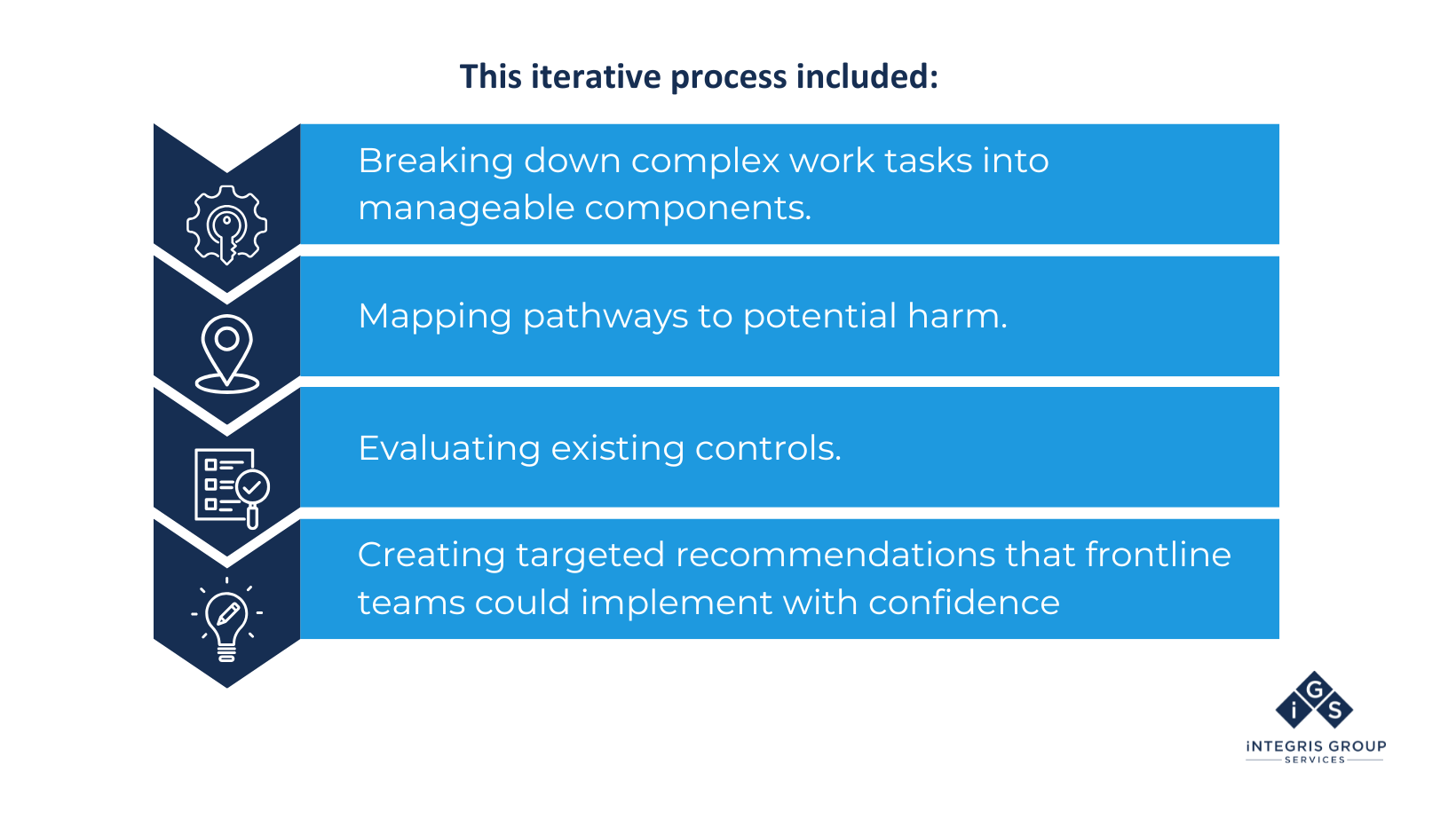
By centering the expertise of those performing the work, the framework remained practical and aligned with real-world challenges, ensuring that hazardous manual handling factors were clearly identified and addressed.
The Power of Collaboration in Manual Handling Safety
Collaboration proved to be the cornerstone of success. By empowering workers to lead discussions, describe their tasks, and share their experiences, the project fostered a sense of ownership and engagement among the team.
Workshops were designed to:
Build on contributions progressively, improving the risk assessment with each session,
Workshops were designed to:
Capture critical insights through on-site visits, photos, and videos, and
Workshops were designed to:
Ensure shared understanding among stakeholders, from frontline teams to management and support staff.
Most importantly, active listening by facilitators and leaders was pivotal. A commitment to understanding the work context and empowering teams to recommend solutions enabled a robust and actionable risk assessment process.
Outcomes and Impact
The collaborative approach led to the identification of five high-risk scenarios related to hazardous manual handling. Recommendations were not only detailed but translated into actionable plans and communication tools.
These outputs served multiple purposes:
Enabling frontline teams to implement immediate safety controls,
Engaging senior leadership, design, and engineering teams to address risks at their source, and
Providing a replicable framework for tackling other high-risk tasks across the organisation.
This methodology has set the stage for broader application, offering a pathway to embed safety-focused innovations into daily operations. By ensuring that workers feel empowered and supported, organisations can proactively manage hazardous manual handling tasks with greater precision and care.
Conclusion: Advancing Safety Through Collaboration
Collaboration is redefining workplace safety, especially in managing hazardous manual handling risks. By integrating the expertise of frontline teams with the guidance of safety specialists like Integris Group Services, organisations are setting new benchmarks for safety innovation.

The impact extends beyond safer working conditions—it fosters a culture of proactive risk management, where workers and leaders unite to build safer, more resilient operations. This collaborative approach ensures not only compliance but also sustained improvement, helping organisations navigate the complexities of modern workplaces with confidence.
By prioritising team involvement and expert partnership, organisations can continue to lead the way in manual handling safety, inspiring broader industry advancements and securing a safer future for all.
Ready to enhance workplace safety and implement Hazardous Manual Handling solutions that empower your teams?
Welcome to Integris Group Services. Before you explore our website, we want to inform you about the use of cookies on our website. By continuing to browse and use our site, you are agreeing to our use of cookies as described in our Privacy Policy and Terms & Conditions.
Functional
Always active
The technical storage or access is strictly necessary for the legitimate purpose of enabling the use of a specific service explicitly requested by the subscriber or user, or for the sole purpose of carrying out the transmission of a communication over an electronic communications network.
Preferences
The technical storage or access is necessary for the legitimate purpose of storing preferences that are not requested by the subscriber or user.
Statistics
The technical storage or access that is used exclusively for statistical purposes.The technical storage or access that is used exclusively for anonymous statistical purposes. Without a subpoena, voluntary compliance on the part of your Internet Service Provider, or additional records from a third party, information stored or retrieved for this purpose alone cannot usually be used to identify you.
Marketing
The technical storage or access is required to create user profiles to send advertising, or to track the user on a website or across several websites for similar marketing purposes.
risk assessment group, manual handling assessment geelong, manual handling risk management, manual handling assessment melbourne, workplace safety innovation, manual handling assessment bendigo, risk assessment manual handling, cvf full form in safety, online manual handling assessment, what is a manual handling risk assessment, manual handling risk assessment
Engaging Frontline Workers in Safety Solutions
Engaging frontline workers is essential in developing effective safety solutions for hazardous manual handling. Their firsthand experience provides invaluable insights into the risks and challenges they face daily, allowing for tailored interventions that are both practical and effective.
By involving workers in the risk assessment process, organizations can foster a culture of safety where employees feel valued and empowered. This collaborative approach not only enhances the accuracy of assessments but also promotes buy-in from the team, leading to higher compliance and safer work environments.
Innovative Tools for Risk Assessment
Utilizing innovative tools for risk assessment can significantly enhance the effectiveness of safety strategies in hazardous manual handling. Technology, such as mobile applications and data analytics, allows for real-time monitoring and assessment of workplace risks, making it easier to identify and mitigate hazards.
For instance, digital platforms can streamline the documentation process, enabling teams to quickly capture and analyze data related to manual handling tasks. This not only improves the accuracy of risk assessments but also facilitates ongoing safety training and awareness among employees.
Case Studies: Successful Implementations of Collaborative Safety Frameworks
Case studies of organizations that have successfully implemented collaborative safety frameworks provide valuable lessons and inspiration for others. These examples illustrate how tailored approaches to risk assessment can lead to significant improvements in workplace safety and employee engagement.
For example, a manufacturing company that adopted a collaborative framework reported a 30% reduction in manual handling injuries within a year. By sharing insights and experiences among teams, they enhanced their risk management strategies and fostered a proactive safety culture.
The Role of Leadership in Safety Culture
Leadership plays a critical role in fostering a strong safety culture within organizations. Effective leaders prioritize safety and encourage open communication about risks, empowering employees to participate actively in safety initiatives.
By demonstrating commitment to safety through regular training, resource allocation, and visible support for safety programs, leaders can inspire a collective effort toward improved manual handling practices. This not only enhances safety outcomes but also boosts morale and productivity among teams.
risk assessment group, manual handling assessment geelong, manual handling risk management, manual handling assessment melbourne, workplace safety innovation, manual handling assessment bendigo, risk assessment manual handling, cvf full form in safety, online manual handling assessment, what is a manual handling risk assessment, manual handling risk assessment
Engaging Frontline Workers in Safety Solutions
Engaging frontline workers is essential in developing effective safety solutions for hazardous manual handling. Their firsthand experience provides invaluable insights into the risks and challenges they face daily, allowing for tailored interventions that are both practical and effective.
By involving workers in the risk assessment process, organizations can foster a culture of safety where employees feel valued and empowered. This collaborative approach not only enhances the accuracy of assessments but also promotes buy-in from the team, leading to higher compliance and safer work environments.
Innovative Tools for Risk Assessment
Utilizing innovative tools for risk assessment can significantly enhance the effectiveness of safety strategies in hazardous manual handling. Technology, such as mobile applications and data analytics, allows for real-time monitoring and assessment of workplace risks, making it easier to identify and mitigate hazards.
For instance, digital platforms can streamline the documentation process, enabling teams to quickly capture and analyze data related to manual handling tasks. This not only improves the accuracy of risk assessments but also facilitates ongoing safety training and awareness among employees.
Case Studies: Successful Implementations of Collaborative Safety Frameworks
Case studies of organizations that have successfully implemented collaborative safety frameworks provide valuable lessons and inspiration for others. These examples illustrate how tailored approaches to risk assessment can lead to significant improvements in workplace safety and employee engagement.
For example, a manufacturing company that adopted a collaborative framework reported a 30% reduction in manual handling injuries within a year. By sharing insights and experiences among teams, they enhanced their risk management strategies and fostered a proactive safety culture.
The Role of Leadership in Safety Culture
Leadership plays a critical role in fostering a strong safety culture within organizations. Effective leaders prioritize safety and encourage open communication about risks, empowering employees to participate actively in safety initiatives.
By demonstrating commitment to safety through regular training, resource allocation, and visible support for safety programs, leaders can inspire a collective effort toward improved manual handling practices. This not only enhances safety outcomes but also boosts morale and productivity among teams.