

Executive Communication Strategies
Winning Government Tenders Starts Before You Write
Employee engagement surveys can tell you that something is wrong.
They do not necessarily tell you why.
A declining engagement score might point to frustration, fatigue, poor morale or declining confidence in leadership. An organisation can respond by introducing wellbeing initiatives, recognition programs, team activities or other employee experience measures.
Some of those initiatives may be valuable.
But if the underlying problem is excessive workload, unclear accountability, inconsistent leadership, poor communication or badly designed work, improving the employee experience around the problem does not necessarily resolve the problem itself.
This distinction matters.
Employee engagement is often treated as something organisations need to increase. A more useful question for boards and executive teams is:
What is happening within our organisation that is producing the engagement results we are seeing?
That question shifts the conversation from employee sentiment to organisational systems.
And in an environment where Australian organisations are paying greater attention to psychosocial hazards, workforce wellbeing and organisational culture, understanding that distinction is becoming increasingly important.

Compliance Gets You Into the Process. It Does Not Necessarily Win It.
Government procurement is structured.
Tender documentation may establish mandatory requirements, response schedules, evaluation criteria, contractual conditions, submission rules and other requirements suppliers need to address.
Meeting those requirements matters.
A response that misses a mandatory requirement, fails to provide requested information or does not follow submission instructions may create an avoidable procurement risk.
But compliance alone does not necessarily create a compelling tender.
Several bidders may satisfy the requirements.
The evaluation team still needs to distinguish between them.
That means organisations should consider two questions separately:
Can we submit a compliant response?
and
Can we demonstrate why selecting us represents a strong outcome for the buyer?
The first is about eligibility and compliance.
The second is about competitive positioning.
Successful tender strategy requires both.

Stage 1: Make a Deliberate Bid or No-Bid Decision
Not every tender should be pursued.
One of the most expensive tendering mistakes is committing significant organisational resources to an opportunity simply because it exists.
Before proceeding, leaders should assess whether there is a genuine basis for competing.
This includes considering:
- alignment between the opportunity and organisational strategy,
- mandatory and threshold requirements,
- relevant experience and demonstrated capability,
- capacity and resources to deliver,
- commercial and contractual exposure,
- strength of available evidence,
- competitive positioning,
- relationships, partnerships or subcontracting requirements, and
- the realistic probability and value of success.
This creates a bid or no-bid decision, rather than an automatic decision to participate.
A disciplined no-bid can be as valuable as a successful bid.
It protects resources, reduces distraction and allows the organisation to concentrate its tender capability on opportunities where it can present a credible proposition.
The key question is not simply:
Can we bid?
It is:
Why should we believe we can win and successfully deliver this contract?

Stage 2: Understand What the Buyer Is Actually Trying to Achieve
Tender documents contain requirements.
Strong tender teams look beyond the requirements to understand the outcome behind them.
A government agency may be procuring a service because it needs to improve capability, address an operational problem, manage risk, increase service coverage, achieve policy objectives or replace an existing arrangement.
Those circumstances shape what matters to the buyer.
Before drafting responses, the tender team should develop a clear understanding of:
- the required outcomes,
- the operating environment,
- the stakeholders affected,
- the risks the buyer may be trying to manage,
- the evaluation criteria,
- the evidence required to establish confidence, and
- the practical consequences of successful delivery.
This helps prevent a common problem in tender writing: answering the question technically while failing to address the buyer’s underlying concern.
If a criterion asks about implementation methodology, for example, the evaluator may not simply want a project plan.
They may be asking:
Can this supplier mobilise without disrupting our operations?
A stronger response answers both questions.

Stage 3: Build the Win Strategy Before Writing the Response
Once the opportunity is understood, the organisation needs a clear position.
What will distinguish the submission?
Why is the proposed approach credible?
What evidence supports it?
What risks could make the evaluator hesitate?
A useful win strategy connects the buyer’s priorities with the organisation’s capability.
For each major evaluation criterion, tender teams should be able to identify:
Requirement → Response → Evidence → Benefit
If the buyer requires strong governance, do not simply state that your organisation has strong governance.
Explain the governance model.
Identify who is accountable.
Describe how issues are escalated.
Show where the model has worked previously.
Then explain how that approach reduces delivery risk for the buyer.
This moves the submission from assertion to evidence.
Government evaluators should not have to infer why your capability matters.
Make the connection clear.

Stage 4: Treat Evidence as a Core Part of the Tender
Statements such as “we have extensive experience”, “our people are highly qualified” or “we are committed to quality” are easy to write.
The stronger question is:
What can we show?
Evidence might include relevant case studies, performance results, qualifications, delivery metrics, references, systems, governance arrangements, certifications where relevant, risk controls or examples of comparable work.
The quality of the evidence matters as much as its quantity.
A case study is more useful when it demonstrates relevance to the requirement rather than simply describing a large previous client.
A performance metric is stronger when the evaluator understands what was achieved and why that result matters.
A policy is useful when it is supported by evidence that the policy is embedded in practice.
Strong tender responses consistently connect claims with proof.

Stage 5: Make Risk Part of the Value Proposition
Risk should not be treated as a section that is completed near the end of the tender.
Government buyers need confidence that suppliers understand what could affect delivery and have credible mechanisms for managing it.
Depending on the procurement, this may include consideration of:
- mobilisation and transition risk,
- workforce availability,
- service continuity,
- subcontractor and supply chain dependencies,
- workplace health and safety,
- information and data management,
- financial and commercial exposure,
- regulatory or contractual obligations, as well as
- performance and reporting requirements.
The strongest responses do not attempt to suggest that risk does not exist.
They demonstrate that risk has been understood and can be managed.
That creates confidence.

Stage 6: Use a Compliance Matrix to Control the Submission
Government tenders can involve multiple schedules, attachments, mandatory requirements, word limits, evidence requests and contractual declarations.
Managing this through email and individual memory creates unnecessary risk.
A compliance matrix provides a central control mechanism.
Depending on the tender, it can capture:
| Requirement | Response owner | Evidence required | Status | Review |
|---|---|---|---|---|
| Mandatory requirement | Assigned lead | Supporting document | In progress | Compliance review |
| Evaluation criterion | Subject matter expert | Case study / evidence | Draft | Strategic review |
| Pricing schedule | Commercial lead | Pricing model | Pending | Executive approval |
| Declaration | Authorised officer | Signed form | Complete | Final check |
The purpose is simple.
Every requirement should have an owner.
Every claim requiring evidence should have evidence.
Every response should be reviewed.
Nothing should be left to assumption.

Stage 7: Write for the Evaluator, Not for Your Organisation
Tender submissions often become internally focused.
They describe the organisation’s history, capabilities, values, systems and experience at length.
Those things may be relevant.
But the evaluator is ultimately trying to understand what they mean for the contract being procured.
A useful discipline is to continually ask:
So what does this mean for the buyer?
Instead of:
Our organisation has extensive experience delivering complex programs.
A stronger response establishes the experience, demonstrates its relevance and connects it to the buyer’s outcome.
For example:
Our delivery team has implemented comparable multi-site programs in regulated environments, enabling us to apply established mobilisation, governance and escalation processes from commencement.
The difference is subtle but important.
One describes the supplier.
The other helps the evaluator understand the benefit and delivery confidence created by that capability.

Stage 8: Review the Tender Through Different Lenses
Tender review should involve more than proofreading.
Different reviews answer different questions.
A compliance review asks whether every requirement has been addressed.
A strategic review asks whether the response presents a convincing proposition.
A technical review tests whether the proposed solution is accurate and deliverable.
A commercial review examines pricing, assumptions, contractual exposure and financial viability.
An executive review considers whether the organisation can stand behind the commitments being made.
These reviews should occur before the final submission deadline.
A tender uploaded minutes before closing leaves little room to resolve missing documents, portal problems, approval issues or inconsistencies.
Good tender governance includes submission discipline.

Winning the Tender Is the Beginning of the Commitment
A tender is not simply a sales document.
It can become part of the basis upon which the organisation is selected and expected to perform.
That means commitments made during tendering need to be operationally credible.
If the submission promises particular governance arrangements, reporting, personnel, service levels, implementation methods or controls, the delivery team needs to understand those commitments.
This is why tendering should not sit entirely outside operations.
The people who will ultimately deliver the contract should have appropriate involvement before the organisation commits to the response.
Once successful, the transition from tender to contract delivery should be deliberate.
Key commitments, assumptions, risks, milestones, reporting obligations and responsibilities should be transferred into the contract management and delivery environment.
Otherwise, organisations can win work they are not properly prepared to deliver.

What Executives Should Ask Before Approving a Government Tender
For executives, tender approval should involve more than confirming that the document is ready to submit.
Five questions provide a useful starting point.
First, why do we believe we can win this opportunity?
Is there a clear competitive position, or are we simply participating?
Second, can we evidence the claims we are making?
Are our statements supported by credible examples, systems, results and capability?
Third, do we understand the delivery and contractual risk?
Has the organisation considered what it will actually need to do if the tender succeeds?
Fourth, is our proposed solution operationally achievable?
Have delivery teams, subject matter experts and relevant leaders validated the commitments?
Fifth, does the submission make it easy for the evaluator to choose us?
Is the response clear, relevant, evidence-based and directly connected to the buyer’s requirements and desired outcomes?
These questions shift tender approval from document sign-off to organisational decision-making.
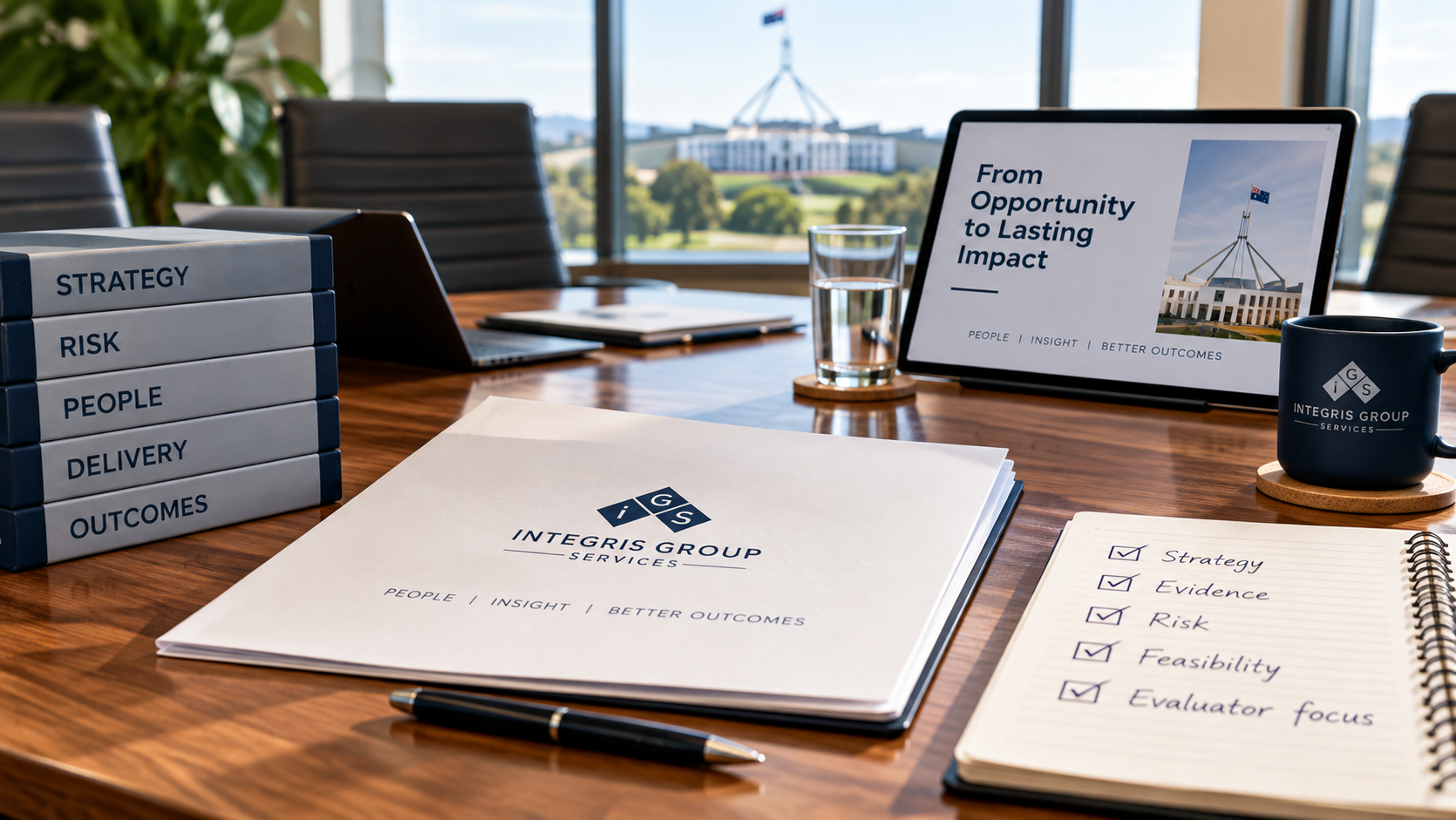
How Integris Group Services Can Support
Integris Group Services supports organisations through the strategic and practical aspects of tender, RFX and grant development.
Our approach goes beyond writing responses.
We can help organisations assess opportunities, structure bid or no-bid decisions, interpret requirements, develop win strategies, coordinate subject matter input, strengthen evidence, establish compliance controls and turn complex organisational capability into clear evaluator-focused responses.
Where required, we can also help organisations examine the governance, risk, policy, process and delivery systems sitting behind the claims they intend to make.
This matters because a strong tender should not promise a version of the organisation that only exists in the submission.
It should demonstrate a credible organisation capable of delivering what it says it will deliver.
The objective is not simply to submit more tenders.
It is to pursue the right opportunities with stronger strategy, stronger evidence and greater confidence in delivery.
Frequently Asked Questions
What makes a government tender successful?
A strong government tender combines compliance with clear strategy, relevant evidence and a credible delivery approach. The submission should make it easy for evaluators to understand why your organisation can deliver the required outcomes.
Should we respond to every government tender we are eligible for?
No. A structured bid or no-bid assessment can help determine whether the opportunity aligns with your capability, capacity, strategy, commercial position and realistic likelihood of success.
What is a tender compliance matrix?
A compliance matrix is a practical tool used to track tender requirements, response owners, supporting evidence, review status and submission requirements. It helps reduce the risk of important requirements being overlooked.
Why is evidence important in a tender response?
Evidence gives evaluators confidence that your claims are credible. Relevant case studies, results, qualifications, governance arrangements, systems and previous delivery experience can help demonstrate that your organisation can deliver what it is proposing.
Can Integris Group Services help with government tender submissions?
Yes. Integris Group Services can support tender and RFX development from opportunity assessment and bid strategy through to response development, evidence, compliance review and submission readiness. Our focus is on helping organisations develop submissions that are strategic, credible and practical to deliver.
Ready to strengthen your next tender submission?
We help organisations turn complex tender requirements into clear, evidence-based submissions that demonstrate capability, manage risk and give evaluators confidence in delivery.