

Employee Engagement Improvement
When Engagement Scores Point to a Bigger Organisational Problem
Employee engagement surveys can tell you that something is wrong.
They do not necessarily tell you why.
A declining engagement score might point to frustration, fatigue, poor morale or declining confidence in leadership. An organisation can respond by introducing wellbeing initiatives, recognition programs, team activities or other employee experience measures.
Some of those initiatives may be valuable.
But if the underlying problem is excessive workload, unclear accountability, inconsistent leadership, poor communication or badly designed work, improving the employee experience around the problem does not necessarily resolve the problem itself.
This distinction matters.
Employee engagement is often treated as something organisations need to increase. A more useful question for boards and executive teams is:
What is happening within our organisation that is producing the engagement results we are seeing?
That question shifts the conversation from employee sentiment to organisational systems.
And in an environment where Australian organisations are paying greater attention to psychosocial hazards, workforce culture, and organisational wellbeing, understanding that distinction is becoming increasingly important.

Engagement Is an Outcome, Not Just a Score
Engagement surveys provide useful information.
They can identify trends, highlight areas of concern and give employees an opportunity to describe their experience of work.
The problem arises when the survey becomes the diagnosis.
Consider an organisation where employees consistently report feeling overwhelmed.
The immediate response might be resilience training, wellbeing resources or additional recognition.
But what if the real problem is that teams are carrying conflicting priorities from different executives? What if approval processes create unnecessary rework? What if vacancies have remained unfilled while service expectations have stayed the same?
The employees may be accurately describing the symptom.
The organisation still needs to diagnose the cause.
This is why engagement should not be considered solely as an HR measure. Workforce sentiment can provide information about how effectively leadership, governance, work design, communication and operational systems are functioning.
When engagement deteriorates, leaders should be interested not only in how employees feel, but also in what within the organisation may be creating that experience.

The Psychosocial Risk Conversation Changes the Question
The growing focus on psychosocial health and safety has made this distinction particularly relevant for Australian organisations.
Psychosocial hazards can arise from the way work is designed, managed and carried out, as well as from workplace interactions and behaviours.
Issues such as high job demands, low job control, poor support, unclear roles, poorly managed organisational change, inadequate recognition, remote or isolated work, traumatic work and workplace aggression can all warrant consideration within an organisation’s approach to psychosocial risk.
This changes the leadership conversation.
An engagement survey might tell an organisation that employees feel unsupported.
A psychosocial risk approach asks:
What conditions of work are contributing to that experience, what risk do they create, and what controls can we implement?
Those are very different questions.
One measures perception.
The other begins examining the organisational conditions behind it.
For boards and executives, this means employee engagement, psychosocial safety and organisational performance should not automatically be treated as separate conversations.
The same underlying system can influence all three.
What Might Actually Be Driving Disengagement?
When engagement results decline, organisations can be tempted to focus immediately on the lowest-scoring survey categories.
A stronger diagnostic approach looks beneath those scores.
Several organisational conditions can influence employee experience.
Leadership behaviour
Employees need a reasonable level of consistency from their leaders.
When expectations, priorities or management responses regularly change depending on the person or situation, employees spend more time interpreting what leadership wants and less time concentrating on delivery.
The issue may therefore appear as dissatisfaction with management while the deeper problem is inconsistent leadership practice.
Governance and accountability
Unclear accountability creates friction.
Two teams may believe they own the same decision. Alternatively, everyone may assume somebody else owns it.
Employees then spend time negotiating responsibilities, escalating avoidable issues and working around organisational ambiguity.
What appears in an engagement survey as frustration can actually be a governance problem.
Role clarity
People perform better when they understand what they are responsible for, what authority they have and how their role connects with others.
Where responsibilities overlap or reporting lines are unclear, employees can experience competing expectations and unnecessary conflict.
A position description alone does not create role clarity. The organisation’s operating model must reinforce it.
Workload and work design
High workload is not always a simple resourcing problem.
It can also be created by inefficient processes, duplicated approvals, poorly designed systems, competing priorities, unnecessary reporting or work being allocated to the wrong level of the organisation.
Before assuming the solution is simply more people, leaders should understand why the workload exists.
Communication
Communication problems are often described as a need to “communicate more”.
That is not always the answer.
The underlying issue may be that employees receive information too late, decisions are made without sufficient context, escalation pathways are unclear or information does not travel effectively between functions.
The question is therefore not simply whether communication occurs.
It is whether the right information reaches the right people at the right time.
Organisational design
Sometimes capable employees are operating inside systems that make good performance unnecessarily difficult.
Structures, workflows, delegations, technology and decision-making processes may no longer align with how the organisation actually needs to operate.
When this happens, disengagement can become an organisational design signal rather than an employee motivation problem.
Your engagement results are telling you something. Do you know what’s driving them?
We help organisations look beyond workforce scores to understand the systems, risks and organisational conditions influencing employee experience — and identify practical opportunities for improvement.

Inclusion Requires More Than Representation
The same principle applies to diversity and inclusion.
Workforce representation is important, but numbers alone do not tell leaders whether people can participate meaningfully once they are inside the organisation.
An organisation may have a diverse workforce while employees still experience limited voice, inconsistent access to opportunity, low psychological safety or perceptions of unfairness.
This is why inclusion needs to be examined through organisational experience as well as workforce composition.
Leaders should be asking whether people can raise concerns, challenge ideas, contribute to decisions and participate without unreasonable fear of negative consequences.
They should also examine whether recruitment, development, promotion, complaints handling and decision-making processes operate consistently and fairly.
This moves the conversation beyond:
Who works here?
towards:
How does our organisation enable people to contribute once they are here?
That distinction can reveal considerably more about organisational culture

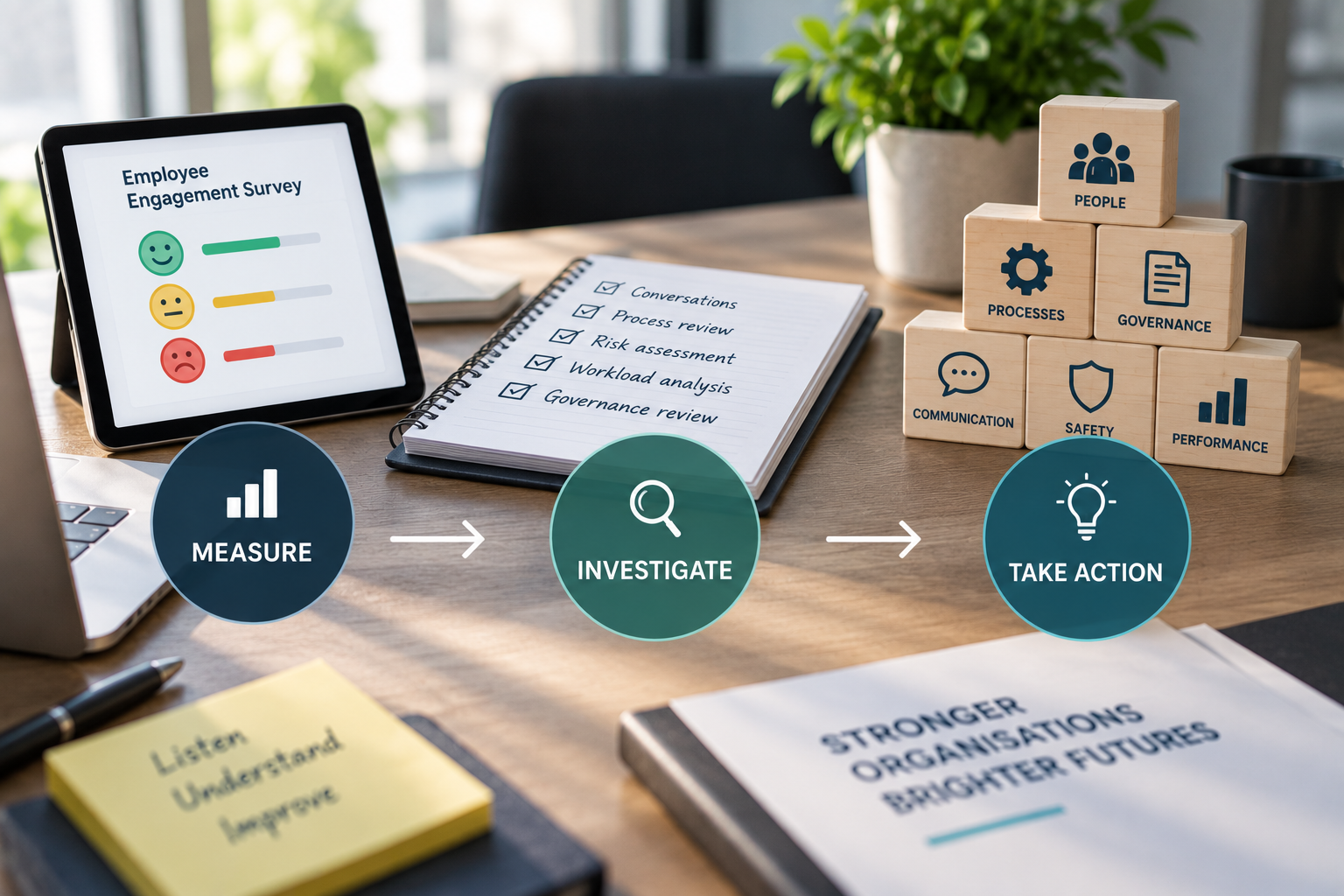
From Engagement Measurement to Organisational Diagnosis
None of this means organisations should stop conducting employee engagement surveys.
It means surveys should be treated as one source of evidence.
If engagement data indicates a problem, the next step should be investigation rather than assumption.
Depending on the issue, that investigation might include:
- structured conversations with employees and leaders,
- psychosocial hazard identification and risk assessment,
- workflow and process reviews,
- analysis of workloads, responsibilities and decision rights,
- governance and accountability reviews,
- examination of complaints, incidents, absenteeism or turnover patterns, as well as
- review of communication, consultation and escalation mechanisms.
Bringing these sources together creates a more complete picture.
For example, a survey might identify low confidence in leadership.
Interviews could reveal inconsistent decisions between managers.
A governance review might then identify unclear delegations.
Workflow analysis could show that employees regularly need approval from multiple leaders for the same activity.
At that point, the organisation has moved beyond measuring dissatisfaction.
It has identified something it can change.
What Boards and Executives Should Ask
Boards and executive teams do not necessarily need more workforce data.
They need information that helps them understand what the data means and what decisions it requires.
A useful starting point is to ask five questions.
First, what organisational conditions are driving our engagement results?
Do we understand the causes behind the scores, or are we responding primarily to employee sentiment?
Second, are workforce concerns connected to identifiable psychosocial hazards?
Where concerns involve workload, role clarity, support, change, workplace behaviour or other work-related factors, have they been considered through the organisation’s risk management processes?
Third, are recurring engagement issues actually governance or operational problems?
Repeated concerns about communication, leadership or workload may indicate problems with accountability, decision-making, work design or organisational structure.
Fourth, what evidence do we have beyond the survey?
Do workforce data, incidents, complaints, turnover, absenteeism, interviews, risk assessments and operational information tell a consistent story?
Fifth, are our actions addressing causes or symptoms?
If the same engagement issue returns survey after survey, it may be worth examining whether previous actions changed the underlying system.
These questions turn engagement reporting from a measurement exercise into a governance conversation.

How Integris Group Services Can Support
Integris Group Services helps organisations understand the systems behind workforce and organisational performance.
Rather than treating employee engagement as an isolated HR issue, we can help organisations examine how governance, leadership, risk, work design, policy, assurance and operational practices interact with employee experience.
Depending on the organisation and the issues identified, support may include organisational diagnostics, governance and accountability reviews, psychosocial risk assessment, policy review, operational process analysis, assurance activities and practical improvement planning.
The objective is not to generate another set of scores.
It is to help leaders understand what is happening, why it is happening and what can realistically be changed.
Conclusion
Employee engagement surveys have value.
But a score cannot explain an organisation.
When engagement declines, the easiest response is to focus on how employees feel and introduce initiatives intended to improve that experience.
The more valuable response is often to ask what the organisation itself may need to change.
Leadership behaviour, workload, role clarity, governance, communication, work design and psychological safety all influence the experience employees have at work.
Surveys can help organisations see the signal.
Good organisational diagnosis helps them find the source.
And when leaders understand the source, they are in a much stronger position to improve employee experience, manage psychosocial risk and build an organisation in which people can perform effectively and sustainably.
Frequently Asked Questions
What can an employee engagement survey tell an organisation?
Employee engagement surveys can identify workforce sentiment, trends and areas of concern. However, survey results should be treated as a source of evidence rather than a complete diagnosis of what is happening within the organisation.
Why might low employee engagement indicate a systems problem?
Low engagement can be influenced by organisational conditions such as unclear accountability, inefficient processes, inconsistent leadership, excessive workloads, poor communication or unclear roles. Understanding these underlying factors helps organisations address causes rather than symptoms.
How are employee engagement and psychosocial risk connected?
Employee concerns about workload, support, role clarity, organisational change or workplace behaviours may indicate conditions that warrant consideration through psychosocial risk management processes. Engagement data can therefore provide useful information for further investigation.
How can organisations move beyond employee engagement scores?
Organisations can combine survey results with employee and leadership conversations, operational data, risk assessments, process reviews, complaints, turnover, absenteeism and governance information. This creates a more complete picture of what may be driving the results.
How can Integris Group Services support employee engagement and organisational improvement?
Integris Group Services can help organisations examine the systems behind workforce performance through organisational diagnostics, governance and accountability reviews, psychosocial risk assessment, policy review, process analysis, assurance activities and practical improvement planning.
Interested in your Organisational Pulse?
We help organisations look beyond workforce scores to understand the systems, risks and organisational conditions influencing employee experience — and identify practical opportunities for improvement.