
Governance, Risk and Compliance
The Challenge Organisations Face
Most regulated organisations already have governance structures – they have risk registers, they have policies, compliance obligations, audits, committees, incident systems and reporting arrangements.
The problem is often not that these things are missing. It is that they are not sufficiently connected.
Governance may operate through board and executive structures. Risk may be managed through separate registers and reporting. Compliance may sit within policies, audits and regulatory activities.
Individually, each system can appear reasonable, but collectively, important information can become fragmented.
A recurring incident may not influence the risk profile. An audit finding may be closed without considering whether it points to a broader control weakness. A policy may be approved without sufficient visibility of whether it is embedded in practice.
This is where governance, risk and compliance need to operate as an integrated system.
The objective is not more administration.
It is better organisational visibility and stronger assurance.
Governance, Risk and Compliance Perform Different Jobs

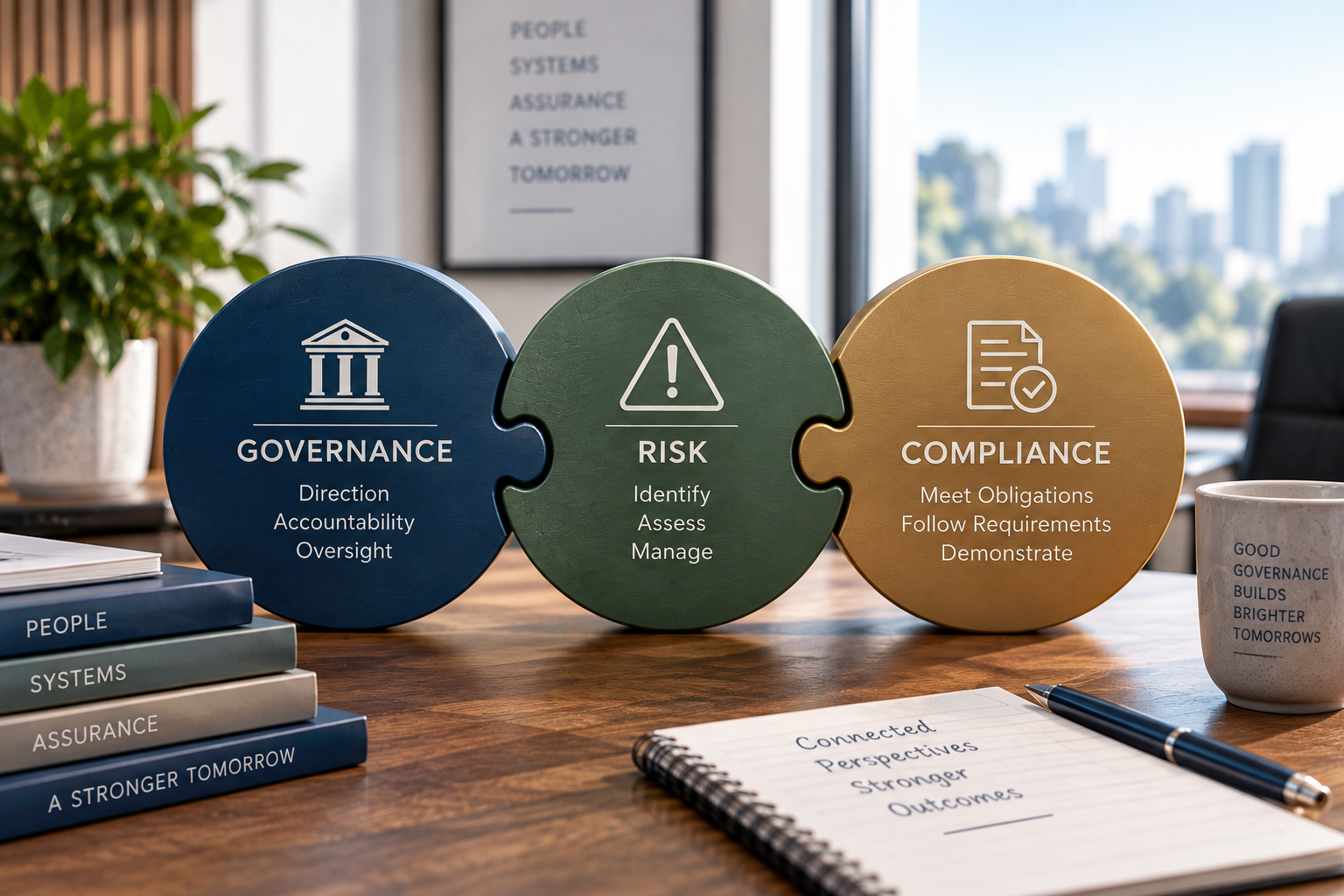
Governance, risk and compliance — commonly referred to as GRC — are closely related, but they are not interchangeable.
Governance establishes direction, accountability and oversight.
Risk management helps the organisation understand uncertainty that could affect its objectives and determine how that uncertainty should be managed.
Compliance helps ensure legal, regulatory, contractual and internal obligations are understood and met.
Each discipline provides a different perspective.
The organisational value increases when those perspectives are connected.
A board needs visibility of material risks to govern effectively.
Risk management needs clear accountability and escalation pathways.
Compliance systems need to reflect organisational risks as well as external obligations.
When those connections are weak, assurance can become fragmented.
Are Your GRC Systems Integrated or Merely Coexisting?
IGS can help you identify gaps, strengthen the connections between your systems and determine where greater assurance is needed.
Fragmentation Can Create False Confidence
One of the challenges with fragmented GRC systems is that each component can appear healthy when viewed independently.
A policy register might show that policies are current.
A risk register might show that risks have been reviewed.
An audit schedule might show that planned audits have been completed.
An incident dashboard might show that incidents are being recorded.
Each measure provides useful information.
But none necessarily tells leadership whether the overall control environment is effective.
Consider a recurring operational issue.
The incident management system records it.
The relevant procedure is updated.
Training is delivered.
The action is closed.
Six months later, the issue occurs again.
A fragmented system may treat that as another incident.
An integrated system asks something different:
Why is this recurring, what does it tell us about our controls, and should it change our understanding of organisational risk?
That is the difference between recording activity and creating assurance.
Strong GRC Connects What the Organisation Knows

Regulated organisations generate significant amounts of governance information.
Policies tell the organisation what should happen.
Risk registers identify what could affect objectives.
Incidents and complaints show where problems are occurring.
Audits test whether systems and controls are operating effectively.
Performance information shows what is changing.
Improvement registers show what the organisation is doing in response.
The value lies in connecting those sources.
For example:
Incident → Trend → Risk → Control → Assurance → Improvement
When these relationships are visible, leaders can distinguish an isolated issue from something systemic.
They can also make better decisions about where attention and resources are required.
Is your risk framework giving leadership a clear picture of what is changing? IGS Governance and Risk services can support organisations to strengthen risk visibility, accountability and oversight.
Governance Should Create Line of Sight

Governance is sometimes discussed primarily in terms of board structures, delegations and policies.
Those things matter.
But effective governance also requires line of sight.
Boards and executives need sufficient visibility to understand whether the organisation is operating within expectations and whether significant issues require attention.
That means reporting should help leadership understand:
- what is changing,
- where material risks are increasing,
- whether key controls are working,
- where obligations may not be consistently met,
- whether improvement actions are producing the intended result, and
- where additional assurance may be required.
Good governance does not mean boards becoming involved in operational detail.
It means ensuring the right information moves through the organisation to the right level of accountability
Risk Registers Should Influence Decisions

A risk register can be comprehensive, current and neatly presented while having relatively little influence on how an organisation operates.
That is a warning sign.
Risk management creates value when it informs decisions.
If workforce capability is identified as a material risk, leadership should be able to see how that risk connects to recruitment, supervision, training, service continuity, incidents and quality outcomes.
If cyber security is a significant risk, it should influence investment, controls, business continuity, workforce awareness and assurance activity.
The question is therefore not simply:
Is the risk on the register?
It is:
What are we doing differently because we understand this risk?
That is a much stronger test of risk maturity.
Compliance Should Be Visible in Practice

Compliance can become overly focused on whether the organisation possesses the correct documentation.
Policies exist.
Registers are maintained.
Training has been completed.
Declarations have been signed.
These may all form part of a sound compliance system.
But they do not necessarily demonstrate that obligations are being met consistently in practice.
A stronger compliance approach tests implementation.
Do people understand their responsibilities?
Are controls operating consistently?
Does practice reflect policy?
Can the organisation produce reliable evidence?
Are weaknesses identified and corrected?
Compliance becomes more meaningful when the organisation moves from:
“Do we have it?”
to:
“Can we demonstrate that it works?”
When was your policy framework last tested against how your organisation actually operates? IGS Policy Development and Review can help identify gaps, duplication and opportunities to strengthen implementation.
Audit Is One of the Bridges Between GRC
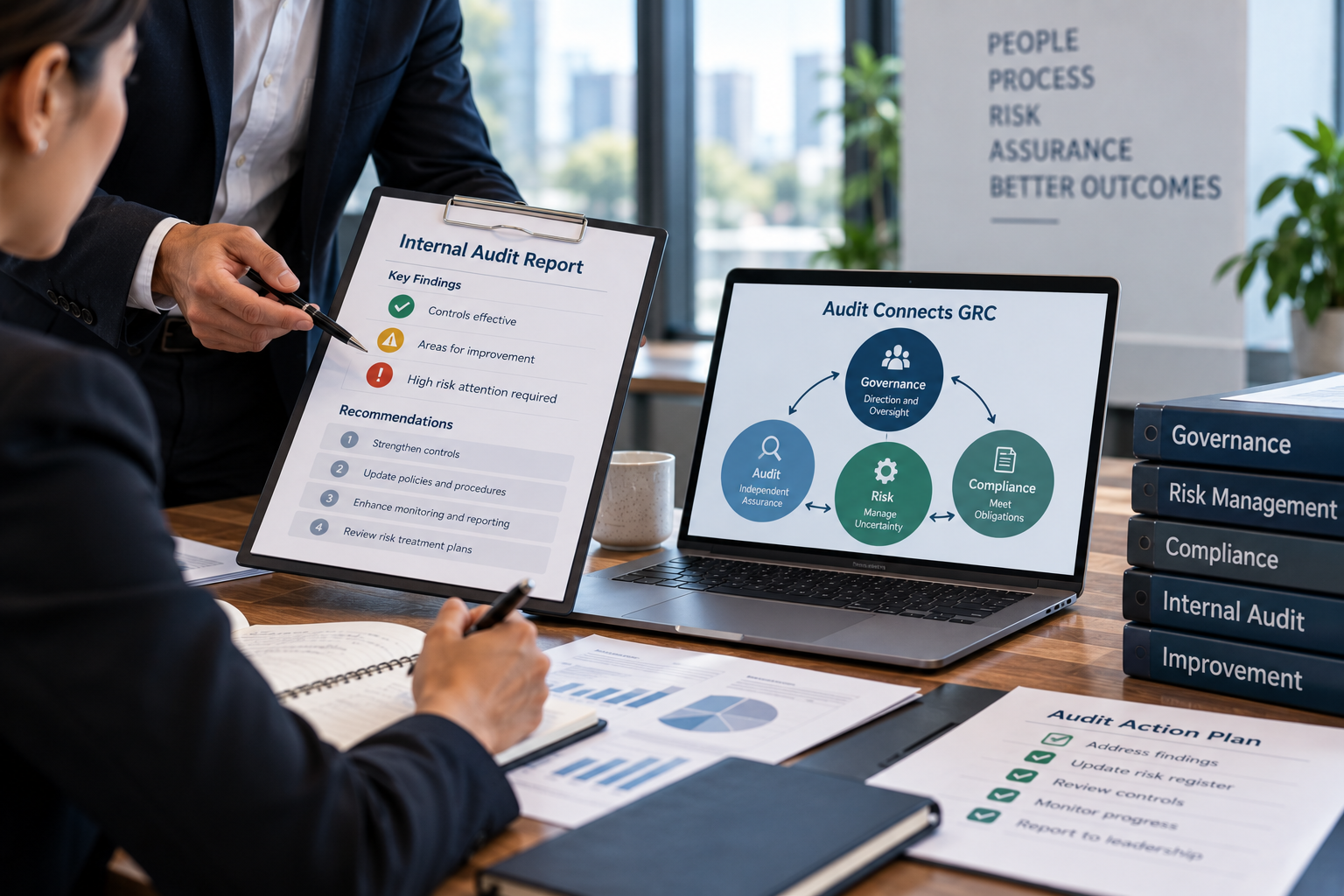
Internal audit has an important role within an integrated GRC environment.
It can test whether governance expectations, risk controls and compliance requirements are actually operating as intended.
This makes audit more than a periodic compliance exercise.
A well-designed internal audit program can help answer:
Are our controls working?
Does operational practice reflect documented requirements?
Are known risks being managed effectively?
Are recurring findings indicating a wider weakness?
Can leadership rely on the assurance it is receiving?
Audit findings should therefore feed back into risk, governance and improvement processes.
When the same issue repeatedly appears in audits without affecting risk assessments, reporting or management attention, an important connection may be missing.
IGS Internal Auditing can provide an independent assessment of whether organisational systems and controls are operating effectively and where improvement should be prioritised.
Look for the Connections Between Incidents, Complaints and Risk

Incidents and complaints are particularly valuable sources of organisational intelligence.
Individually, they may appear operational.
Collectively, they can reveal patterns.
Repeated complaints about communication may indicate a workforce capability issue.
Recurring incidents across multiple sites may indicate inconsistent implementation of a control.
Repeated exceptions to a procedure may indicate that the procedure itself is impractical.
The mature GRC question is therefore not simply:
Was the matter resolved?
It is:
What is this telling us about the wider organisation?
This is where integrated GRC creates learning rather than simply closure.
A Practical Integrated GRC Framework

Organisations looking to strengthen GRC can consider five connected areas.
1. Governance
Clarify accountability, delegations, oversight and escalation.
Ensure leadership receives information that supports meaningful decisions rather than simply reporting activity.
2. Risk
Maintain a current understanding of material risks and ensure risk information influences strategy, operations and assurance activity.
3. Compliance
Translate obligations into practical responsibilities, controls and evidence.
Test whether requirements are embedded rather than relying on documentation alone.
4. Assurance
Use internal audits, reviews, incidents, complaints and performance information to test whether systems are operating effectively.
5. Improvement
Connect findings to accountable actions.
Monitor implementation and verify whether changes have actually addressed the underlying issue.
Integrated GRC creates a continuous cycle: Govern → Understand Risk → Control → Assure → Improve.
What Should Boards and Executives Ask?

Leadership does not need to personally manage every compliance obligation or operational risk.
It does need confidence that the organisation’s systems are connected and producing meaningful assurance.
A practical starting point is:
1. What are our most significant risks, and how are they changing?
2. What evidence tells us our key controls are working?
3. Are incidents, complaints and audit findings revealing recurring themes?
4. Are governance reports providing assurance or primarily reporting activity?
5. Where are we relying on assumptions that have not recently been tested?
These questions change the GRC conversation.
The focus moves from:
“Have we completed the required activities?”
to:
“What do we know about the effectiveness of our organisation?”
Technology Can Connect the System — But It Cannot Create Governance
Integrated platforms can make GRC considerably easier to coordinate.
They can connect obligations, risks, policies, incidents, audits, controls and improvement actions.
They can reduce duplication and improve reporting visibility.
But technology does not create accountability.
A sophisticated GRC platform will not resolve unclear ownership, weak escalation, poor risk conversations or ineffective controls.
The organisation still needs sound governance architecture.
Technology should make those systems easier to operate and understand.
It should not become a substitute for them.
How Integris Group Services Can Support

Integris Group Services supports organisations to strengthen the connections between governance, risk, compliance and assurance.
Depending on organisational needs, this can include governance and risk reviews, policy framework assessment, internal auditing, compliance systems, assurance activities and practical improvement planning.
Our focus is not simply on adding more processes.
It is helping organisations understand what is working, where the gaps are, how are the systems connected, where leadership needs greater assurance and what should happen next.
Frequently Asked Questions
What is Governance, Risk and Compliance (GRC)?
Governance, Risk and Compliance (GRC) is an integrated approach to connecting organisational governance, risk management and compliance activities. Governance establishes direction, accountability and oversight; risk management helps organisations understand and respond to uncertainty; and compliance supports the management of legal, regulatory, contractual and internal obligations.
Why should governance, risk and compliance be integrated?
Integrating GRC helps organisations connect information that may otherwise sit across separate systems, teams and reporting processes. This can give boards and executives greater visibility of material risks, control effectiveness, compliance issues, audit findings and improvement priorities, supporting stronger organisational assurance and more informed decision-making.
How can an organisation tell if its GRC systems are fragmented?
Common indicators include duplicated reporting, disconnected risk and compliance registers, recurring incidents or audit findings, unclear accountability, inconsistent escalation pathways and improvement actions that do not influence broader risk or governance processes. Individual systems may appear effective while leadership still lacks a clear view of how they work together.
How can Integris Group Services help strengthen GRC?
Integris Group Services can support organisations through governance and risk reviews, policy framework assessments, internal auditing, compliance systems, assurance activities and practical improvement planning. The focus is on understanding how existing systems connect, identifying gaps and helping leadership determine where stronger governance, controls and assurance may be required.
How can Integris Group Services support a policy review?
The IGS Policy Review and Improvement Service provides an independent assessment of individual policies and the broader policy framework, helping organisations identify strengths, gaps, duplication and priorities for improvement and develop a practical roadmap forward.
Is Your GRC Framework Giving You the Full Picture?
Governance, risk and compliance may be working individually — but are they working together?
Integris Group Services can help you identify where systems are disconnected, where assurance could be strengthened and what practical improvements should come next.